Artist archive
Bart Forbes
Biography
Bart Forbes – “Impressions of Achievement” – 1986 Sport Artist of the Year

If what he says is true, that “Being an artist is probably one of the neatest things that can happen to a person,” then 1986 Sport Artist of the Year Bart Forbes has lived one of the “neatest” lives of all. A list of Forbes’ sport art reads like a timeline of major sports history. From the Kentucky Derby, the New York and Boston marathons, the Indianapolis 500, and three different Olympic Games, Forbes’ art has been the visual symbol of many great individuals and unforgettable moments. Simply put, Bart Forbes is a sought-after and well recognized sport art icon.
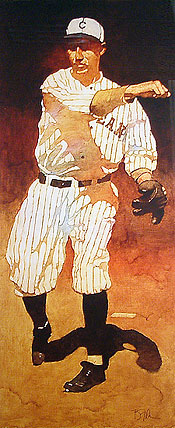
Though he did not start painting until college, Forbes remembers drawing stickmen on the flyleaf of his children’s books when he was three or four years old. “I can’t remember when I didn’t want to be an artist,” he said. Forbes’ parents were supportive of his drive to become an artist, and cultivated his talents. But, like so many young people in the United States, Forbes’ first experiences with sport were also a way of connecting with his father. At the age of seven, Ted Forbes, Bart Forbes’ father, took him to his first major league baseball game at the legendary Wrigley Field in Chicago. His second big league experience came several years later at the Cincinnati Reds’ Crosley Field when Forbes was in high school. The nostalgia of baseball is something Forbes never escaped, and it later manifested in his paintings and his affinity for collecting baseballs with Hall of Famers’ signatures including Babe Ruth, and his personal favorite, Ty Cobb. Forbes’ father also introduced the young artist to the sport of golf, which would eventually become his favorite sport and the subject of some of his most recognized paintings.
Growing up in an Air Force family made Forbes accustomed to travel. Though he was born in Oklahoma, he moved to Cincinnati, Ohio while in high school, graduated from the University of North Carolina, and completed graduate work at the Art Center College of Design in Los Angeles. His prestigious career in art began in the form of the covers of albums and paperback books.
In correspondence with Academy President and CEO Dr. Thomas P. Rosandich, 1985 Sport Artist of the Year Donald Moss nominated Bart Forbes for the 1986 Sport Artist of the Year distinction. Moss wrote that Forbes was both “extremely talented and well deserving” of the award. Forbes’ body of work was reviewed and approved as an important contribution to the world of sport art. American Sport Art Museum and Archives (ASMA) Advisory Board Member John Counts said that “Mr. Forbes has demonstrated a strong interest in sports through his vivid style of painting.” Thus, Forbes was given the award. He then donated 16 original drawings to ASAMA, several recognizable prints, lithographs, and an original oil on canvas of Boston Celtics’ Larry Bird, which now hangs on the wall of the Sport Artist Hall of Fame. His donations contributed to the growing ASAMA collection, bolstering its reputation to what it is today: arguably the largest collection of sport art in the world.
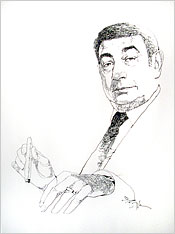
Forbes reminds us that “the Lord gives all of us opportunities, whether we’re farmers or artists or lawyers or doctors or just people who want something else out of life.” This philosophy is embodied in his artwork and is consistent with the mission of the United States Sports Academy, “to prepare men and women for careers in the profession of sports,” to pursue that opportunity, that something else out of life. Whether it be his self-portrait sketch hanging in a wing of the Academy, the oil painting of Larry Bird on the wall of the Sport Artist Hall of Fame, or the painting of the 1996 Men’s Olympic Basketball Team hanging in the Academy’s Academic Conference Room, the sport art of 1986 Sport Artist of the Year Bart Forbes gives visitors to ASAMA and Academy students alike something significant to rally around.
Style & Inspiration
Bart Forbes – “Impressions of Achievement” – 1986 Sport Artist of the Year
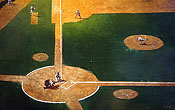
“I’d have to say I was most influenced by the French Impressionists,” Forbes said.1 “I don’t paint like them but I was influenced. I try to create a feel.”1 Perhaps what Forbes meant by this is that, by trying to “create a feel,” he was illuminating the sensory details of his subjects, the color, light, and so forth, not the objects themselves. Of his paintings, Forbes also said, “I don’t paint from photographs.” This reinforces the idea that, though Forbes has used photographs as a point of reference, photographs are concerned with objects, while his paintings are an illustration of their sensory details. The objects emerge from the attempt at creating feeling.
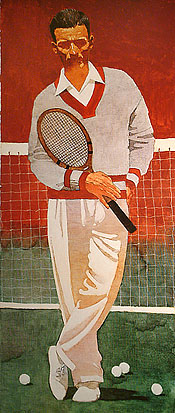
Though Forbes tends to stick with two or three primary colors, and works with a lot of earth tones in his paintings, with oils, he was able to experiment with form, texture, and light.
“There is really not one sport that is more difficult to capture than the rest,” he said. “But it does require more research when I work with sports I have not been involved with, such as polo.”
For the most part, after his research Forbes’ procedure included drawing three pencil sketches and a color thumbnail about an inch wide to explore the color scheme before he began painting.
Forbes was also a fan of jazz music, which he frequently represented in his paintings. The influence of jazz music, its variety and reputation for improvisation, also appear in Forbes’ artistic philosophy. He said, “I try to learn from my mistakes and improvise occasionally, inventing things and letting accidental things happen that contribute to what I do.” But, the haphazard technique the philosophy suggests is not the key to becoming a successful artist, and, according to Forbes, is not a guarantee of good art. “Being an artist isn’t as easy as it might seem,” he said.1 “It takes a lot of dedication to produce what I consider good art. You’re always striving to produce a great painting. I don’t think I’ve ever produced a great painting, but I’ve tried to. I think my best work is ahead of me. I certainly hope it is. I’m always learning and trying to grow.” The combination of creativity and solid work ethic are what made Forbes an ideal candidate for the 1986 Sport Artist of the Year. As they were for the career of Bart Forbes, hard work, creativity, and a love for sport were just a few of the building blocks for the United States Sports Academy.
Key Sport Works & World Influence
Bart Forbes – “Impressions of Achievement” – 1986 Sport Artist of the Year

Forbes is known for his work with watercolor and oils. His art has been called “unique,” “loose and realistic,” and the nature of his style makes his paintings “very identifiable.”2 His commissions include the official paintings for the Kentucky Derby, Indianapolis 500, the America’s Cup, the Westminster Dog Show, the Boston and New York Marathons, numerous watercolors for World Championship Tennis, and posters for the Byron Nelson Golf Tournament. Forbes has designed more than 20 postage stamps for the US Postal Service, one of which was a nostalgic and charming Lou Gehrig commemorative. His distinctive style has been featured in magazines such as Time, Sports Illustrated, McCalls, Boy’s Life, Redbook, TV Guide, and others.
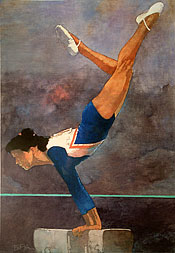
Commissioned paintings were largely a part of how Forbes was able to lead the “neatest” life. Most of his work was commissioned, and he knew how to please his clients. “I paint to meet the needs of my clients… and still satisfy myself,” Forbes said.1 “My gallery painting is completely different. I like to experiment, paint more loosely, more abstract.”1 But, though he worked mostly with watercolor through college, it was commissioned work that brought Forbes to working with oils. “I worked for a number of years in watercolor exclusively,” Forbes said.1 “Some time back I was asked to do some very large paintings, but they were too large to do in watercolor.”1 So, Forbes primed a piece of masonite and painted it with oils. “I chose oil and found as I started painting, I could do things that I couldn’t with watercolors,” he said.1 With this oscillating versatility in mediums, Forbes became an indispensable commercial commodity. His corporate clients are a roster of business giants: NBC, GE, ESPN, ABC-TV, Exxon, Pepsi-Cola, Kodak, Miller Brewing, RCA, Marlboro, Phillips Petroleum, Sony, Anheuser-Busch, and Proctor and Gamble for starters. Forbes also enjoyed a 15-year affiliation with the NFL, and as the theme artist for Super Bowl IX.
In 1988, Forbes was selected by the International Olympic Commission (IOC) as the Official Artist for the Games of the XXIV Olympiad in Seoul, Korea. This was a very significant Olympic Games for athletics and politics, and especially for Forbes. He was commissioned to paint 2 X 3 foot oil sketches of each sport and the opening and closing ceremonies. Forbes visited Korea twice for the Games, once before, and once during the Games. While at the Games, Forbes had planned to spend most of his time there sketching. But, when he opened his sketchbook and began to draw, “crowds of curious onlookers would appear, making concentration difficult,” he said.1 So, Forbes depended upon his camera and telephoto lens to shoot hundreds of slides, as many as possible for each event. The result was 26 canvases and a rapidly growing, yet already established reputation as a premier sport artist. Based on this and other work, the U.S. Olympic Committee commissioned Forbes for the official art of both the 1992 Games of the XXV Olympiad in Barcelona, Spain and the 1996 Games of the XXVI Olympiad in Atlanta, Georgia.
In addition to the many paintings available for viewing at the American Sport Art Museum and Archives (ASAMA), Forbes’ paintings grace the walls of private collections belonging to the Smithsonian Institute, former Presidents Jimmy Carter, Ronald Reagan, and George H.W. Bush, Arnold Palmer, Pat Summerall, Tiger Woods, and Ben Hogan. His paintings may also be found in the NFL and PGA Halls of Fame, the Dallas Cowboys owner Jerry Jones’ private jet, and the Atlanta Braves Hall of Fame. Forbes painted Pebble Beach, the Players Championship, and the Ryder Cup for the PGA Tour, Hockey goalie Martin Brodeur for the New Jersey Devils, and mural-size canvasses for the PGA’s TPC Clubhouse at Sawgrass. His paintings include “nearly every major boxing match” including Ali versus Holmes, Hagler versus Hearns, and Leonard vs. Hearns. With all of these achievements, it is no wonder Forbes has received over 50 awards of excellence from the New York Society of Illustrators. A photographic collection of his sport art is available in his book, The Sport Art of Bart Forbes (1998, Beckett Publications).