
Steven Lester
Unstoppable
Improbable Olympian Stories as Seen Through Contemporary Paintings
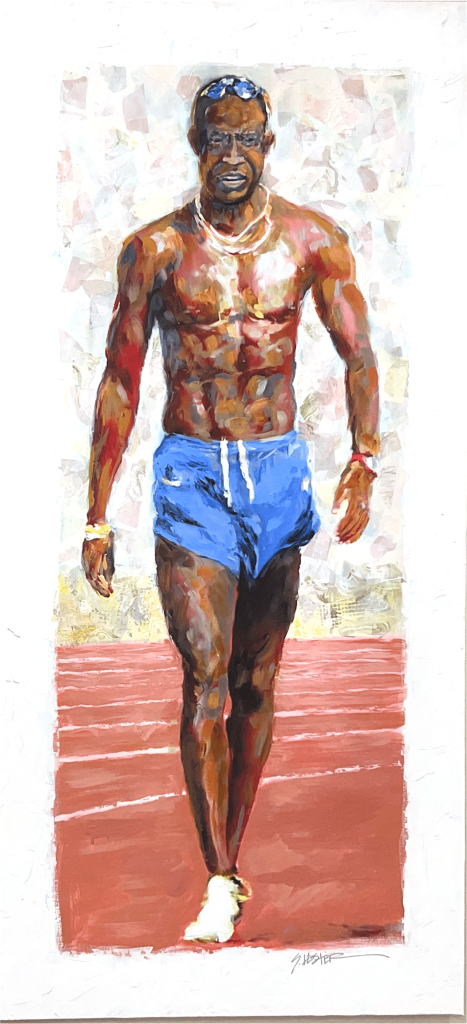
“Running for His Life”
Steven Lester
Sport Artist of the Year: 2019
Acrylic and collage on canvas cradled panel
2020
68 x 33 in
Lopez Lomong was only six years old when he was kidnapped from church during the Second Sudanese Civil War. He was taken from his family and imprisoned, becoming one of the thousands of children known as the Lost Boys of Sudan.
“I was locked in prison to die,” he said. Somehow, a group from his village helped him escape. He spent roughly three days running until he reached Kenya, where he later lived for years in a refugee camp. Eventually, Catholic Charities helped pave the way for him to come to the United States.
Lomong has viewed his life as a means of spreading hope to others who have not yet reached their dreams. In 2008, his fellow U.S. Olympians selected him as the American flag bearer for the Opening Ceremony. In 2012, he reached the Olympic 5,000-meter final.
Today, Lomong continues to use his story to help others, including work supporting families in South Sudan recovering from generations of warfare. The boy who once ran for his life eventually ran for his adopted country.
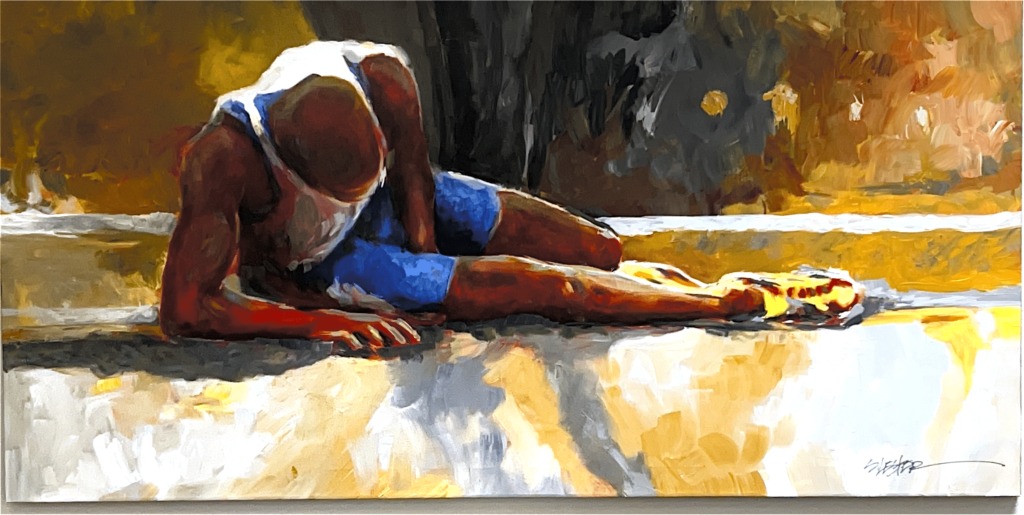
“Fallen Runner”
Steven Lester
Sport Artist of the Year: 2019
Acrylic on canvas
2019
36 x 72 in
He may not have won a medal at the 1992 Olympic Games, but the determination British sprinter Derek Redmond displayed still serves as inspiration for countless athletes.
Redmond was in top form, clocking some of his fastest times. He started strongly in the 400-meter semifinal and was in good position before disaster struck. He tore his hamstring and collapsed to the track, clutching his thigh. Medics approached with a stretcher, but Redmond had other ideas. In excruciating pain, he pushed himself back onto his feet and began hobbling toward the finish line.
As he struggled around the bend, Redmond’s father leapt from the crowd and made his way onto the track to help his son. In one of the most heartwarming moments in Olympic history, Redmond tearfully continued toward the finish, supported by his father, as thousands of fans rose to salute his courage.

“Blind Archer”
Steven Lester
Sport Artist of the Year: 2019
Acrylic and paper collage on cradled panel
2019
44 x 40 in
South Korea’s Im Dong Hyun is legally blind, yet he set a world record for men’s archery at the London Olympics – breaking his own previous record. He also captured team gold medals at the Athens and Beijing Olympic Games.
His vision has been measured at 20/200 in his left eye and 20/100 in his right. He has said that he could not read a newspaper at arm’s length, yet he has no problem hitting a target the size of a grapefruit from a distance more than three-quarters the length of a football field.
Im says he relies on distinguishing between the bright colors on the target. “When I look at the target,” he says, “it looks as if different color paints have been dropped in water… all I can do is try to distinguish between the different colors.”
In a sport that demands incredible focus and sight, Im has overcome an extraordinary obstacle and continues to hit the mark.

“Race Against Hate”
Steven Lester
Sport Artist of the Year: 2019
Acrylic on canvas
2019
40 x 40 in
Jesse Owens was the grandson of an enslaved man and the son of a sharecropper. Born in 1913 in rural Alabama, by age seven he was expected to pick 100 pounds of cotton a day.
Owens became one of the greatest athletes in track-and-field history. At the 1935 Big Ten meet, he set three world records and tied another, all in less than an hour – an extraordinary feat.
The 1936 Olympics in Nazi Germany were part of Adolf Hitler’s effort to promote the supposed superiority of the “Aryan” race. Hitler hoped German athletes would dominate the Games, but Jesse Owens, a Black American, upstaged that narrative by winning four gold medals and becoming a hero to the people of Berlin.
Remarkably, when Owens returned to America, he still faced segregation and discrimination. President Franklin D. Roosevelt did not invite him to the White House or publicly acknowledge his triumphs.
Decades later, President George H. W. Bush awarded Owens the Congressional Gold Medal and described his victories in Berlin as “an unrivaled athletic triumph, but more than that, a triumph for all humanity.”
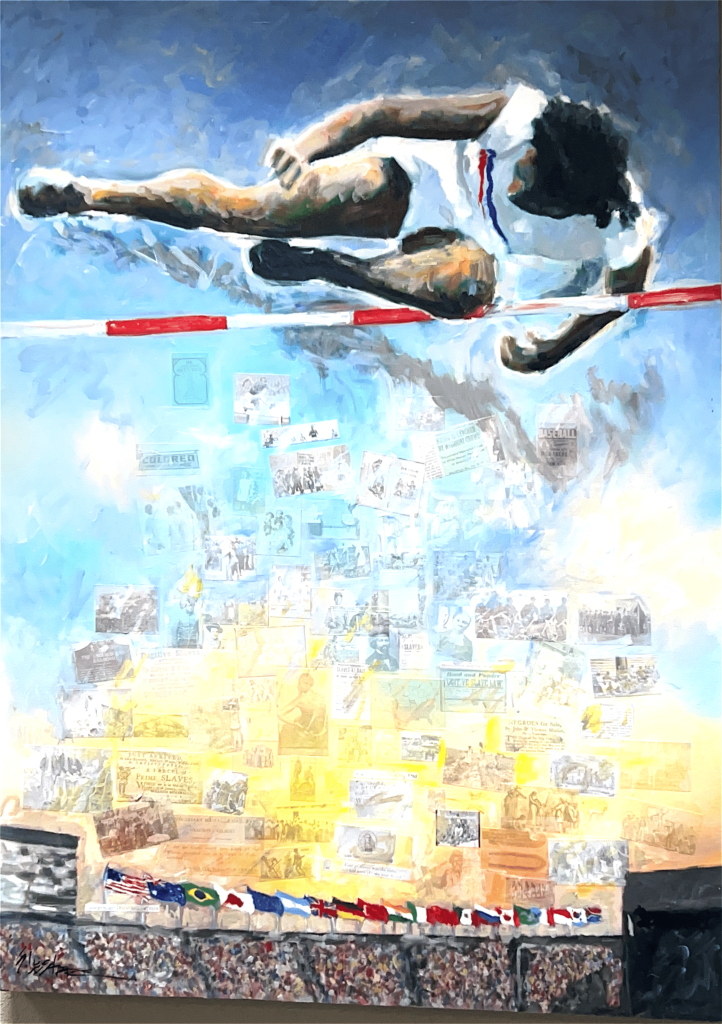
“Leaping Over History”
Steven Lester
Sport Artist of the Year: 2019
Acrylic and paper collage on canvas
2020
42 x 54 in
Alice Coachman was born in 1923 in the segregated South. Young Black athletes could not use many training facilities or compete freely in organized sporting events. Alice trained by running barefoot in fields and on dirt roads, improvising her high-jump practice by leaping over tied rags, ropes, and sticks.
While still in high school, she broke collegiate and national high-jump records -barefoot. Her talent caught the attention of Tuskegee Institute, where she became a champion in basketball and track and field. In all, she held an incredible 25 national titles.
Finally, in 1948, Coachman competed in London as a member of the U.S. Olympic team. Despite nursing a back injury, she rose to the occasion and won the high jump, becoming the first Black woman to win an Olympic gold medal. She was also the only American woman to win a gold medal at the 1948 Games.
She returned home a hero, but racism did not take a break. At a celebration in her hometown, Black and white citizens were seated separately, the mayor refused to shake her hand, and she was required to leave through a side door. Coachman had leapt over history – even as history still had barriers left to clear.
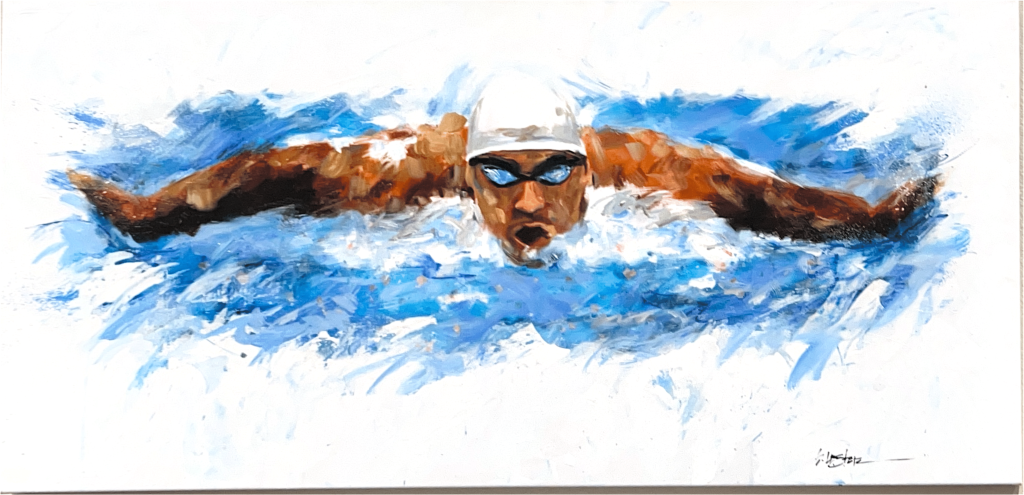
“Take a Deep Breath”
Steven Lester
Sport Artist of the Year: 2019
Acrylic and resin on canvas
2020
24 x 48 in
Michael Phelps began swimming at age seven, partly because of the influence of his sisters and partly to provide an outlet for his abundant energy. In sixth grade, he was diagnosed with attention-deficit/hyperactivity disorder (ADHD).
Phelps went on to become the most successful and most decorated Olympian of all time, winning 28 medals. But those extraordinary achievements came with their own difficulties.
Phelps has spoken openly about his struggles with ADHD and depression, including periods of profound despair after the Olympic Games. Following a 2014 DUI arrest and suspension, he withdrew from others and reached one of the lowest points of his life.
Eventually, Phelps began speaking publicly about his mental health, hoping his story might make a difference for others facing similar struggles. His journey is a reminder that even the greatest champions can fight battles hidden beneath the surface – and that asking for help can itself be an act of strength.
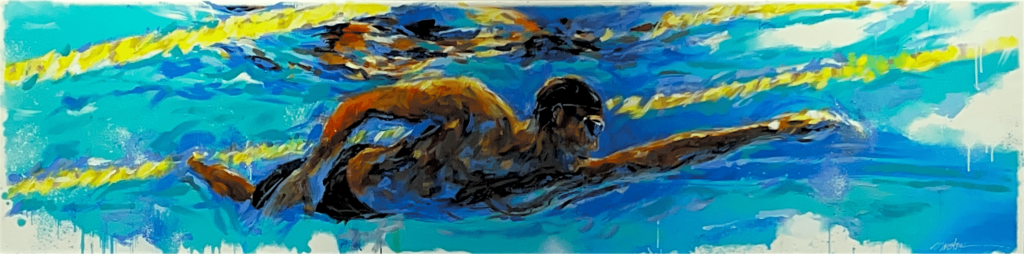
“Eric the Eel”
Steven Lester
Sport Artist of the Year: 2019
Acrylic on canvas
2019
24 x 96 in
To bring the Olympic spirit to developing nations in the late 1990s, the Olympic movement allowed a small number of “wild card” athletes to join the Games. A swimmer from Equatorial Guinea named Eric Moussambani trained in a small hotel pool and had never even seen an Olympic-size pool or raced more than 50 meters. Regardless, he was determined to represent his country.
At the 2000 Sydney Games, Eric dove in well, but soon began gasping for air and struggling through the unfamiliar distance. As he neared the end of the race, the crowd rallied and cheered him on. When he finally touched the wall, the applause thundered.
His final time was far slower than those of the elite swimmers, but his perseverance made him an Olympic celebrity. His newfound fans affectionately dubbed him “Eric the Eel.” He did not win a medal, but he embodied the courage to enter the arena, persevere, and finish.
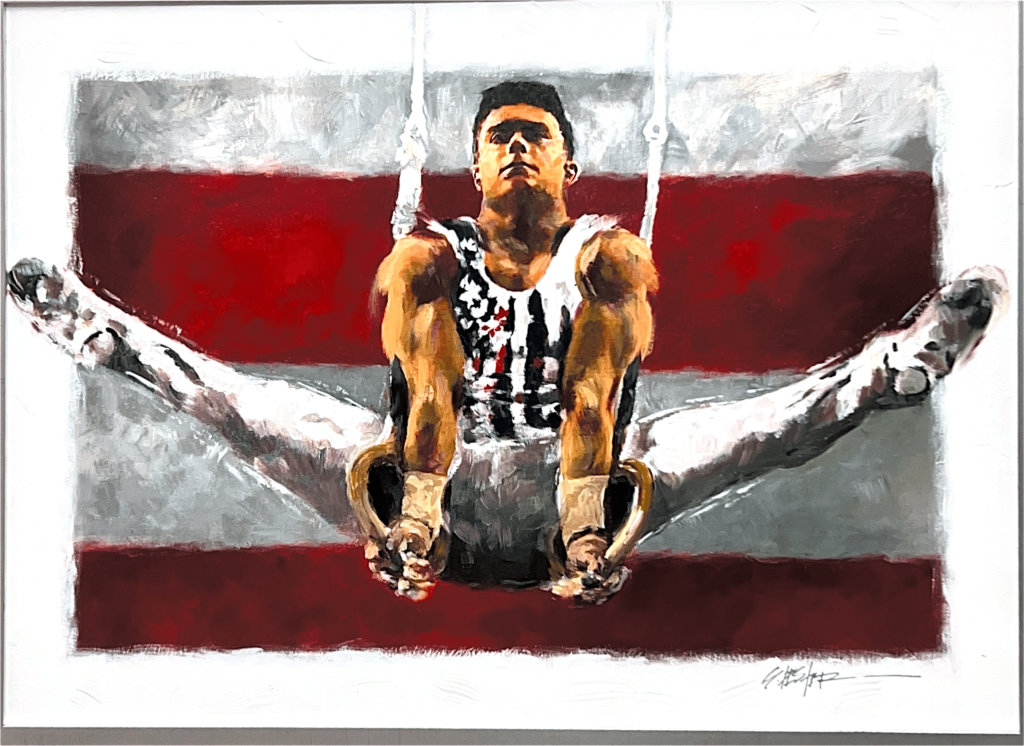
“Straining Against Adversity”
Steven Lester
Sport Artist of the Year: 2019
Acrylic on canvas cradled panel
2023
30 x 42 in
His high-bar routine at a World Cup event in 2023 began with Brody Malone cruising through the same set that had earned him a gold medal at the 2022 World Championships.
Then Malone slipped during his dismount and crashed to the mat. His right leg went one way and the rest of his body went another. Lying on the ground in agony as the arena fell silent, Malone had fractured his leg and shredded multiple ligaments in his knee.
His leg might have broken, but Malone’s fighting spirit never ruptured. He braced for the first of three surgeries necessary simply to help him walk normally again.
For many athletes, it could have been career-ending. Not for the former rodeo rider who knew from experience that when you are thrown from a horse, you get back up.
Growing up, Brody had already learned something about resilience. His mother died of cancer when he was 12; seven years later, his stepmother died following a brain aneurysm. Facing those losses helped forge the grit and perspective he would need to navigate his way back to an extraordinary return to competition.
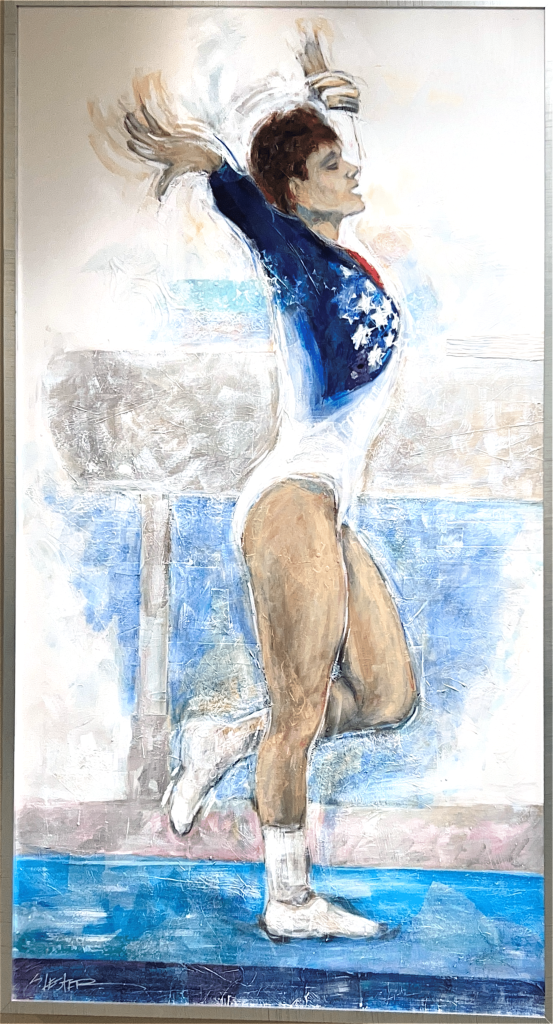
“Landing on Her Feet”
Steven Lester
Sport Artist of the Year: 2019
Acrylic and paper collage on canvas
2022
36 x 64 in
It was an event the Soviet Union had dominated for decades. But the “Magnificent Seven,” as the U.S. women’s gymnastics team was known, stood on the brink of history at the 1996 Games in Atlanta. A first-ever U.S. Olympic team gold in women’s gymnastics was within reach. Only the vault remained. Then came gut wrenching drama.
The pressure fell on 18-year-old Kerri Strug. On her first vault, she landed awkwardly, fell backward, and injured her ankle. Strug had one more chance, but she was limping and the pain was increasingly evident.
Her coach urged her on: “You can do it!” In what became one of the most talked about moments in Olympic history, Strug made one final run. She completed the vault, landed on one good foot, lifted her injured foot, and held the landing long enough to finish before collapsing onto the mat.
Strug had to be carried to the medal ceremony. It became one of the defining images of the Atlanta Games. In the era of superhero movies, few superhero landings can hold a candle to Kerri Strug’s unforgettable vault on an injured ankle.

“Refuge in the Water”
Steven Lester
Sport Artist of the Year: 2019
Acrylic on canvas
2020
36 x 52 in
Yusra Mardini fled the war in Syria and set off on a perilous journey toward Greece in an overcrowded dinghy. Fifteen minutes into the sea crossing, the boat’s engine failed. Determined not to let her fellow passengers drown, Yusra and other swimmers entered the water and helped guide the struggling boat for hours until the passengers reached safety.
A year later, Yusra’s courage, determination, and swimming ability carried her to a very different body of water. She became a member of the first Refugee Olympic Team and competed at the 2016 Olympic Games in Rio, representing millions of displaced people around the world.
Mardini later became the youngest-ever Goodwill Ambassador for the United Nations High Commissioner for Refugees. Her story was also dramatized in the film “The Swimmers.”
Her message of hope, determination, and courage reminds us that people who flee their countries are not defined only by what they have lost, but by what they can still become.

“Olympic Picasso”
Steven Lester
Sport Artist of the Year: 2019
Acrylic on canvas
2020
30 x 44 in
Born in England, Roald Bradstock was diagnosed with spina bifida and hydrocephalus. Until age 14, he was monitored to determine if and when he would need a shunt. His parents were advised that he should not play contact sports. Instead, he took up the javelin and rapidly rose to an international level.
In addition to competing in the Olympics, Bradstock had an obsession with art. He received international attention while competing at Olympic trials not because he broke records, but because he wore brightly colored, hand-painted outfits and threw hand-painted javelins – each matching corresponding outfit. The media nicknamed him the “Olympic Picasso.”
In 2000, he won the United States Olympic Committee Sport Art competition with his painting “Struggle for Perfection,” which was later exhibited at the IOC’s Olympic Museum in Lausanne.
Bradstock later became Executive Director of Art of the Olympians and was appointed to the IOC’s Culture and Olympic Heritage Commission. At the 2018 Winter Olympic Games, he participated in the first Olympic Artist-in-Residence program – art created by Olympians, about Olympians.
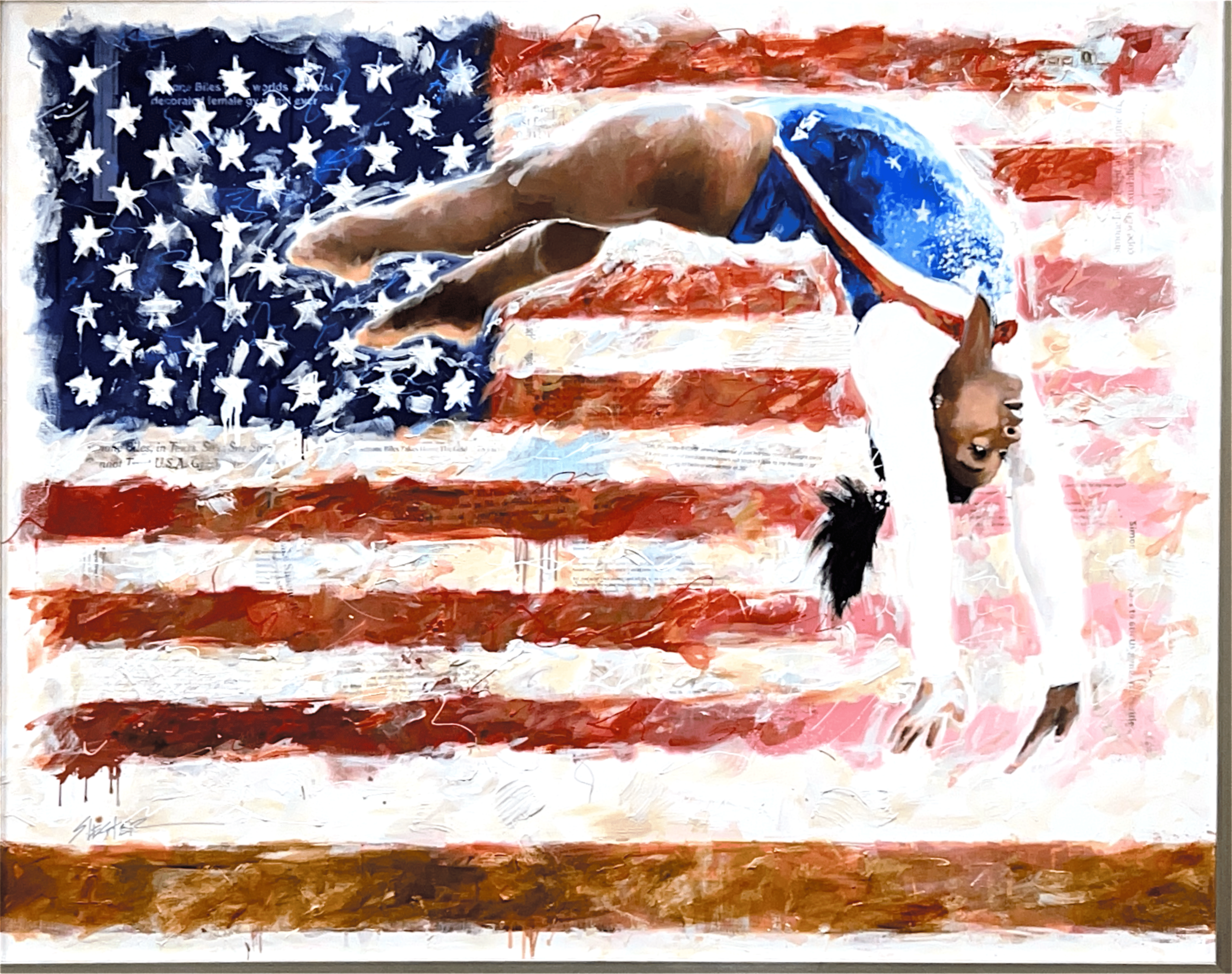
“Soaring to New Heights”
Steven Lester
Sport Artist of the Year: 2019
Acrylic and paper collage on cradled panel
2020
42 x 54 in
Gymnast Simone Biles was raised by her grandparents after her mother’s struggle with substance abuse led to Biles entering foster care. She discovered gymnastics at an early age during a daycare field trip. Her extraordinary talent would make her one of the greatest gymnasts in history, but it was her passion and determination that helped her persevere through numerous obstacles.
Her story is filled with acts of courage. As a muscular child, she endured mocking and body-shaming by classmates. As a young Black girl in artistic gymnastics, she competed in a sport where few athletes looked like her and sometimes felt out of place. Later, she became one of the survivors who spoke publicly about sexual abuse by former USA Gymnastics physician Larry Nassar and the institutional failures surrounding it.
Biles has faced adversity, dark days, and enormous public pressure. Yet she continued to enter the arena and do what she does best – tumbling, spinning, and soaring her way into the record books while continually redefining what was thought possible.
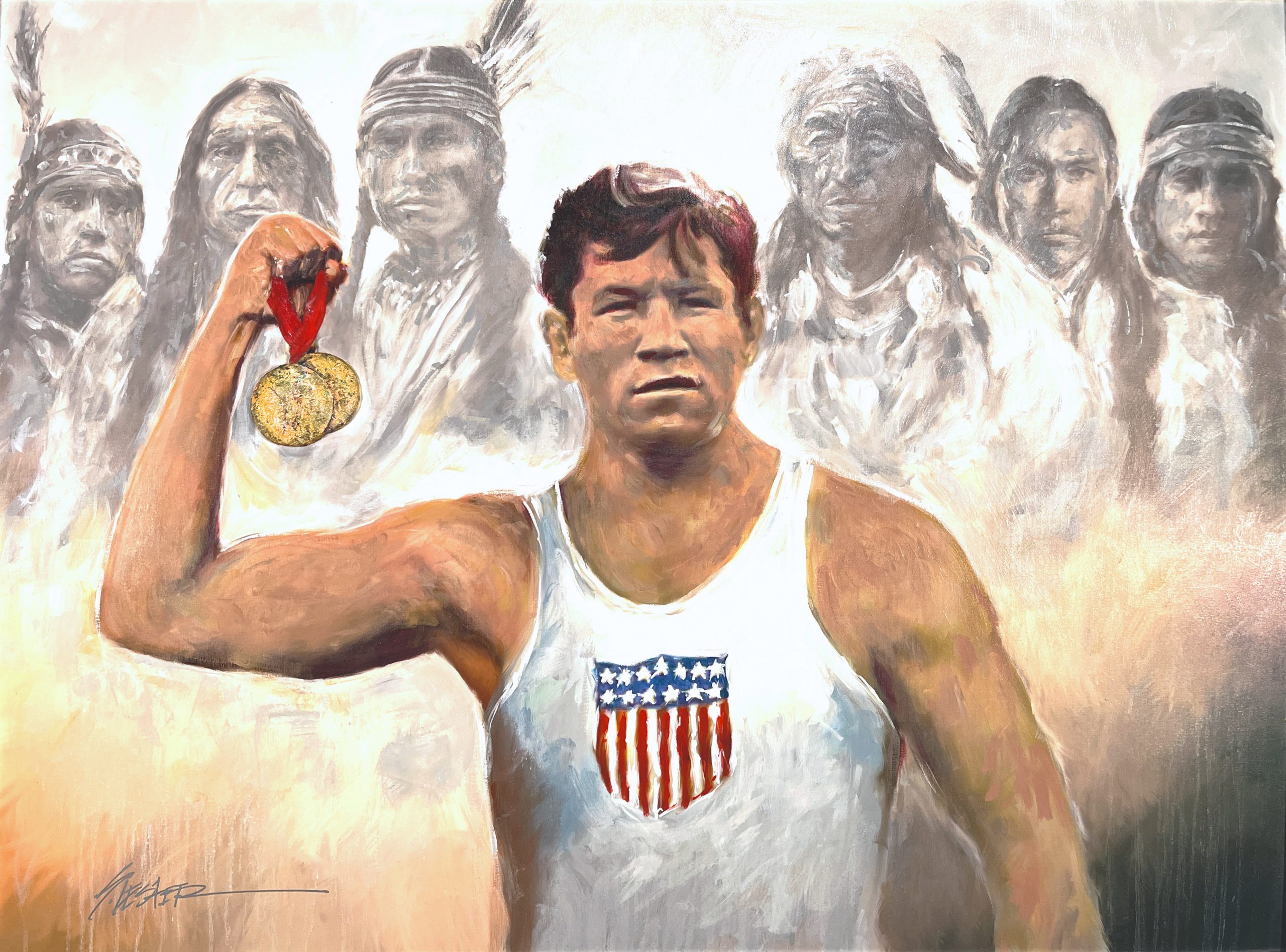
“Native American Warrior”
Steven Lester
Sport Artist of the Year: 2019
Acrylic with gold leaf on canvas
2023
30 × 40 in
Wa-Tho-Huk, better known as Jim Thorpe, was a member of the Sac and Fox and Potawatomi Nations. Thorpe was a warrior in virtually every athletic arena he entered. Orphaned as a teenager and raised as a ward of government schools, he endured a life filled with adversity that helped forge his extraordinary determination.
At the 1912 Olympic Games in Stockholm, Thorpe dominated the pentathlon, winning four of its five events. A week later came the grueling three-day decathlon. He opened by running the 100 meters in 11.2 seconds—a time not equaled in the Olympic decathlon for another 36 years. When his shoes disappeared during the competition, Thorpe reportedly found two mismatched shoes and competed in them, wearing an extra sock because one was too large. He went on to win gold medals in both the pentathlon and decathlon.
Yet one of the greatest athletes in history would also become the victim of one of sport’s great injustices. The International Olympic Committee later stripped Thorpe of his medals after determining that his earlier participation in minor-league baseball violated the amateur rules of the era.
Nearly three decades after Thorpe’s death, the IOC restored Olympic recognition to him. His legacy has only grown with time. He has been honored as one of the greatest athletes of the twentieth century—a Native American athlete whose extraordinary ability, resilience, and dignity transcended both sport and the prejudice of his era.

“Father of Modern Olympics”
Steven Lester
Sport Artist of the Year: 2019
Acrylic and wood
2023
32 x 42 in
Born into the French aristocracy, Baron Pierre de Coubertin became a champion of educational reform. He set out to give French children what he admired in British schools: a greater role for sport in education. By age 25, he had become a leader in French education reform.
He organized an international congress on physical education and began building a network of educators, political leaders, cultural figures, and sports advocates who could help fulfill his Olympic dream. On June 23, 1894, at the Sorbonne in Paris, his proposal to revive the Olympic Games won approval.
Coubertin wrote, “Olympism is not a system, it is a state of mind.” Over time, the modern Olympic Games grew into a global celebration bringing athletes and nations together through sport.
Perhaps his best-known expression of the Olympic ideal captures the heart of the Unstoppable exhibition: “The important thing in life is not triumph, but the struggle; the essential thing is not to have conquered but to have fought well.”
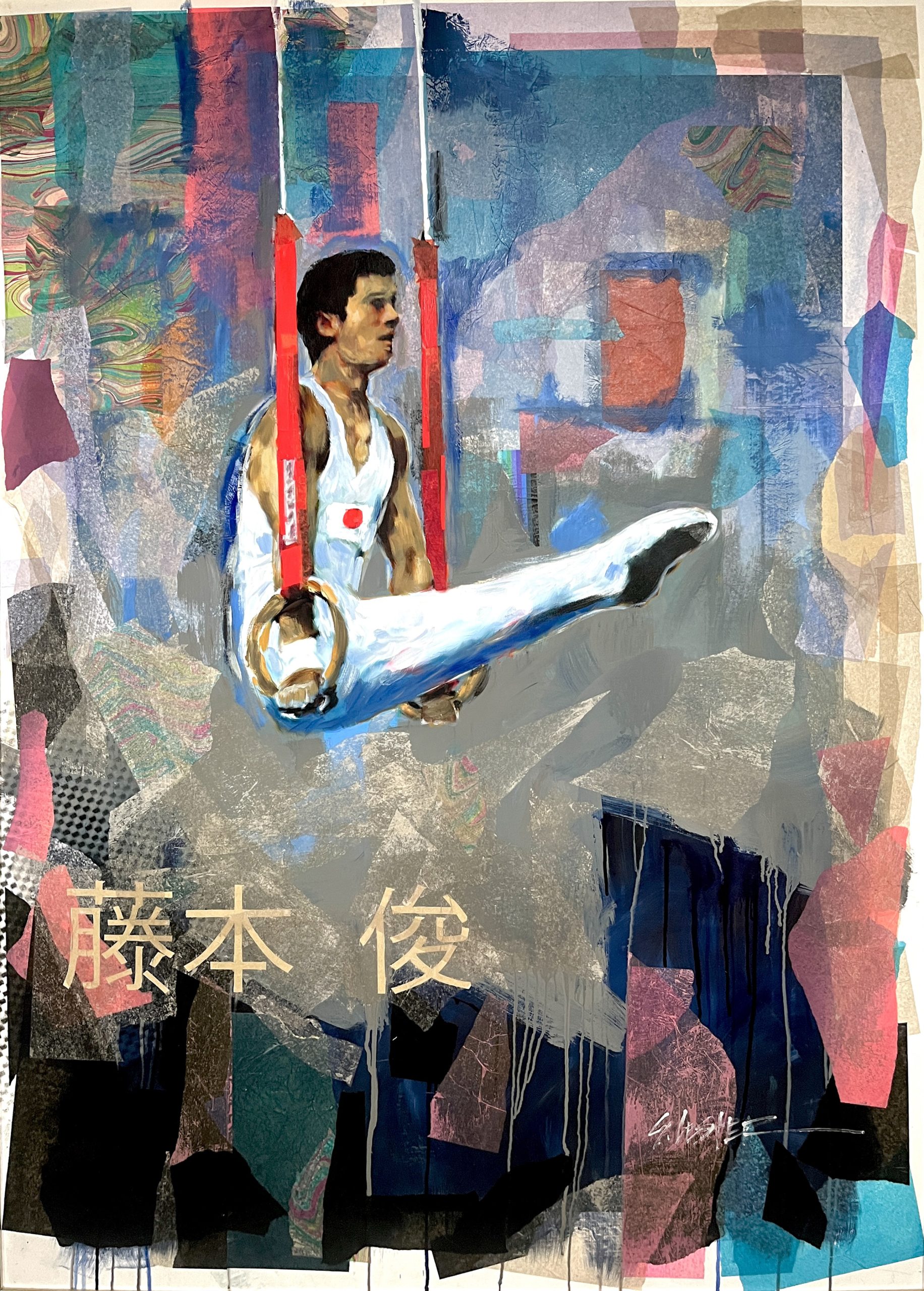
“Persevering through Pain”
Steven Lester
Sport Artist of the Year: 2019
Acrylic and paper collage on cradled panel
2019
52 x 45 in
In 1976, Japanese gymnast Shun Fujimoto suffered a devastating injury during his final tumbling run in the floor exercise. He had fractured his right kneecap and damaged ligaments in his right leg. Japan was in a tight race for team gold, so Fujimoto hid the severity of his injury and moved to the next event – the pommel horse. Despite the pain, he scored a 9.5.
His next event was the rings – seemingly an impossibility with a broken knee. Fujimoto finished with a twisting triple-somersault dismount from eight feet in the air, landing with his injured knee somehow buckling only slightly. He scored a career-high 9.7. Gritting his teeth, he staggered away and collapsed into the arms of his coach.
Doctors ordered him to withdraw from the competition. His performance inspired his teammates, and Japan went on to win the team gold in one of the closest competitions in Olympic history.
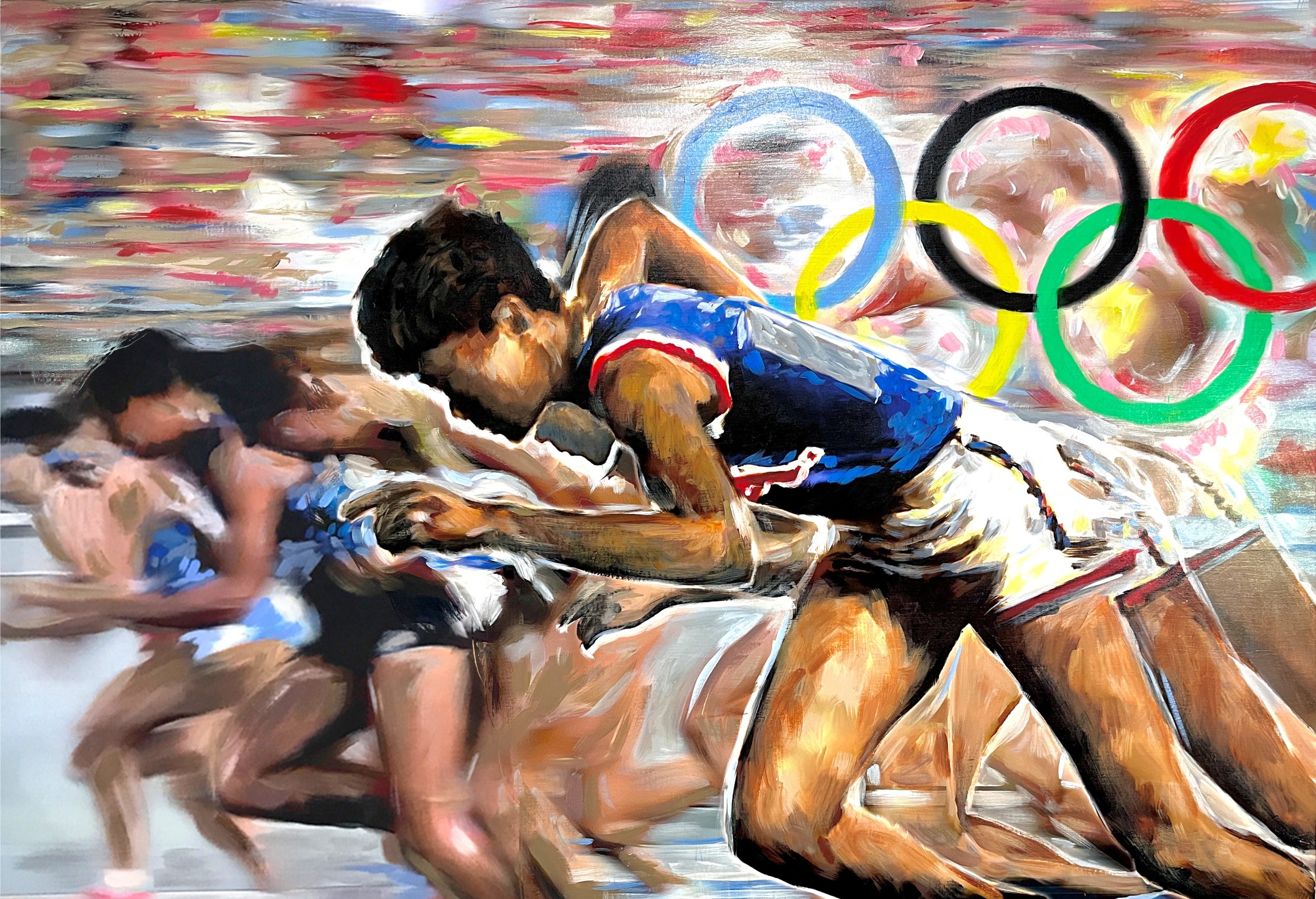
“Race to Greatness”
Steven Lester
Sport Artist of the Year: 2019
Acrylic on canvas
2019
36 x 52 in
Born prematurely in rural Tennessee, Wilma Rudolph was the twentieth of twenty-two siblings. She suffered from several childhood illnesses, including pneumonia, scarlet fever, and paralysis caused by polio. She lost strength in her twisted left leg and foot and received a bleak diagnosis: her doctor said she would never walk again.
But at age six, Rudolph began to hop on one leg. By eight, she could move around with leg braces. At eleven, her mother discovered her playing basketball. She quickly became a natural athlete and eventually focused on track and field.
At the 1960 Olympic Games in Rome, Rudolph won three gold medals and broke world records. Her remarkable performance earned her the title “the fastest woman in the world.” The child once told she would never walk had raced her way into Olympic history.