Artist archive
Bernie Fuchs
Biography
“Caravaggio in Car Ads” – 1991 Sport Artist of the Year

Fuchs was born in O’Fallon, Illinois, a small coal mining town outside of St. Louis, in 1932, to Leo and Florence Fuchs. O’Fallon, now a fast growing community, at the time did not have a hospital, and so Bernie was born at home.
Though his first art class was not until his senior year in high school, Fuchs remembered doodling in his school notebooks. He liked to draw Disney characters such as Donald Duck and Pinocchio. Fuchs was attracted to the work of illustrators in the day’s popular magazines. He recalled being fascinated by an illustration of a beer bottle with beads of sweat. He admired the work of illustrators Joe Bowler, Joe DeMers, and Coby Whitmore.
After his industrial accident, Fuchs enrolled in Washington University School of Fine Arts to pursue a degree in illustration. After his first year of school, Fuchs applied and was accepted to work in a puppet factory. Fuchs worked on an assembly line painting the heads of the Rice Krispie cartoon characters, Snap, Crackle, and Pop. Soon, Fuchs was fired for incompetence.
While at Washington University, Fuchs developed a relationship with a military veteran and fellow student, Walt Heanie. Fuchs admired Heanie’s ability to draw, and Heanie accepted Fuchs as a kind of protégé. “He gave me a book on figure drawing by Andrew Loomis, a popular New York illustrator and said, ‘you study these drawings,’” Fuchs said. “He would give me an assignment almost every day.”
Fuchs set up in his grandfather’s basement to work on his “assignments” at night. It was in that basement that Fuchs encountered the kinds of failures that only drive perfectionists farther. Fuchs said, “I’ll never forget throwing the paint, the brushes, the drawing board, and everything across the basement floor and against the wall and crying—literally. Finally I pulled myself back together, picked up the stuff and started over again. The next morning I would take it in to Walt and he would point out where I was wrong.”
Fuchs opted to obtain a certificate rather than complete the degree program at Washington University. He was eventually awarded with the Outstanding Alumnus award and a fellowship to work in Paris. Graduation from the Fine Arts program proved to be only the beginning of Fuchs’s long and prolific illustrating career.
Style & Inspiration
Bernie Fuchs – “Caravaggio in Car Ads” – 1991 Sport Artist of the Year

At the time when Fuchs was celebrating immense success in the illustration field, the profession of illustrator was quickly becoming endangered. Photography was creeping up as the premier avenue for advertising and “illustration.” Yet Fuchs was never threatened by photographs. His creativity and drive to remain at the top of his field led to a unique approach to integrating and adapting photography into his art. “It doesn’t really matter whether an assignment is done by the artist or by the camera,” Fuchs said. “The point is, is the story illustrated right?”
Fuchs typically began his illustrations with photographs—often his own—and then projected them on canvas. With careful cropping and frequent diagonals in his compositions, he created a legacy of the form. For Fuchs, there was little distinction between fine art and his illustrations. “I’m making pictures. I don’t differentiate,” he said. The American Sport Art Museum and Archives (ASAMA) recognized Fuchs’s impact on the sport art world and honored him as 1991 Sport Artist of the Year.
Borrowing from Degas’s horizontal compositions and compositions from master photographer Henri Cartier-Bresson, Fuchs has worked with casein, acrylics, watercolor, pen-and-ink, and other mixed media. His favorite medium, however, is oils. Oils proved to be the best way to capture the impressionistic varied use of light with which the artist was so fascinated. But, he came to like oils by accident.
While working on an assignment forLithopinion magazine, Fuchs was painting English pubs and wanted to capture the amber color of a mug of ale with the sunlight behind it. He tackled the assignment with oils, but was displeased with the result. When Fuchs wiped the oil paint off with a rag, the resulting color was exactly what he had imagined.
Thus, Fuchs began creating the variations of color from light by wiping out oil paints with a brush or cloth dipped in turpentine. Because of the experience, many of Fuchs’s painting have an amber glow with varying temperatures of orange, red, or green. “Painting is not about color but about value. This is one of the best lessons I ever learned,” he said.
Part of Fuchs’s success can be attributed to his ability to adapt. A renowned illustrator, Robert Heindel, said, “Bernie’s brilliance was that he could take the same assignment that everyone else got and do something special with it.” But for Fuchs, adaptation was simple. He said, “Today’s editorial people look for the guy they know will do something he hasn’t done before… If a job you do reverts to what you were doing two years ago, then, I think, you’re in real trouble.”
Walt Reed said Fuchs’s “pictures are probably more admired—and more imitated—than those of any other current illustrator.” His impact on art can still be felt today, and while he may not have been able to hit the high “C” on the trumpet, Fuchs was able to hit unparalleled highs in illustration and the sports art community.
Key Sport Works & World Influence
Bernie Fuchs – “Caravaggio in Car Ads” – 1991 Sport Artist of the Year

After completing his education, Fuchs set his sights on Detroit. Fuchs accepted an illustrating job at New Center Studio, which was owned by an aggressive businessman named Art Greenwald. New Center Studio designed illustration, photography, paste-ups, and other advertisement media for Detroit’s large automobile industry. At the time, automobile industry advertising could be found in the furthest corners of the country.
After some time with New Center, Fuchs left with five others to form The Art Group in Detroit. Fuchs’s growing popularity in the advertising industry and unparalleled work ethic made The Art Group an immediate success. “Things just sort of happened,” Fuchs said. The Group needed to hire more talent because the client base grew so quickly. Before long, The Art Group was one of the largest studios in Detroit.
Fuchs’s smashing success only increased his appetite. He soon outgrew Detroit and headed for New York City to work as a freelance illustrator. What happened next was an exponential growth of accomplishments. By the age of 30, Fuchs was voted “Artist of the Year” by the Artists Guild of New York. He was the youngest person ever elected to the Illustrators Hall of Fame.
Fuchs’s impact on the field of illustration was significant. Then, advertisers started planning double page spreads that allowed new freedoms to illustrators, with unconventional layouts and typography. Fuchs was the leader of innovative illustration.
Fuchs illustrated the leading most profitable magazines of the time including McCall’s, Cosmopolitan, Ladies’ Home Journal, Redbook, TV Guide, The New Yorker, andSports Illustrated. He was the recipient of more than 100 awards, including the prestigious Hamilton King Award, and was commissioned to design four United States Postal Stamps.
In 1962, Fuchs was commissioned to paint the portrait of President John F. Kennedy. That portrait is now in the permanent collection of the Kennedy library. He was also invited to the White House to paint a portrait of Lyndon Johnson, which is now in the National Portrait Gallery in Washington D.C.. Fuchs painted many prominent American and international figures including Martin Luther King Jr., Queen Elizabeth, Anwar Sadat, and Presidents Gerald Ford, Jimmy Carter, and Ronald Reagan. He painted entertainers like Johnny Carson, Carol Burnett, Dan Rather, Bing Crosby, Katharine Hepburn, Clark Gable, and Sean Connery.
The illustration business was good to Fuchs, but because he had nearly conquered the field, he began to grow tired of it. “The illustration business started boring the hell out of me,” Fuchs said. “I no longer enjoyed working on the projects that I was getting.” So, when Tully Rector, president of an international film company, approached Fuchs about filming commercials, he left illustration behind to fully immerse himself in filmmaking. During this time, Fuchs filmed commercials and industrial films, doing whatever it took to capture unique camera shots. His creativity in film earned him awards from the Art Directors Club for a commercial for Mountain Dew.
Fuchs also illustrated books. His first book illustration was published by Reader’s Digest. Several of the books he illustrated were reproduced classics such as Ernest Hemingway’s A Farewell to Arms. Fuchs also wrote and illustrated his own work of fiction.Ride Like the Wind, A Tale of the Pony Expresswas published in 2004.
Fuchs’s creative arm also reached into the field of teaching. Fuchs joined the faculty of the Famous Artists School at the suggestion of friend and prominent illustrator Austin Briggs. After leaving the Famous Artists School, Fuchs was one of the founders of the Illustrators Workshop. Fuchs eventually lost his interest in teaching a new generation of illustrators. He said, “When I was an illustrator I was always working toward a goal, such as illustrating for magazines. By 1985, the goals were just about gone. People had no goals to inspire them to work long hours, and I couldn’t mislead them into thinking that they were going to find satisfying long-term careers in this field.”
Fuchs began specializing in sports illustration during the 1960s. He was known for going to great lengths to achieve the most authentic representation of sports themes. Fuchs stood behind a net while Sandy Koufax threw a ball directly at him. He stood behind a plexiglass barrier while Gordie Howe shot a puck at him.
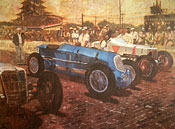
Because of this willingness to get so close to his subjects, and a “dynamic, impressionistic style and use of light [that] seemed to capture the action of sports in a particularly effective way,” Fuchs was able to create genuine representations of the human body in motion. He has been called the “most successful sports illustrator of the second half of the 20th Century.” Fuchs was commissioned to do work for the Indianapolis 500, the running of the bulls in Pamplona, and portraits of Muhammad Ali, Wilt Chamberlain, Arnold Palmer, Jack Nicklaus, and Reggie Jackson to name a few.
His limited edition prints are displayed in the PGA World Hall of Fame. In an article forAmerican Artist magazine titled “Art in Sports,” Ervine Metzl said of Fuchs’s work “his golf tournament is a blaze of movement in which the stroke is so dominant that the player himself is only part of the stroke.”