Artist archive
Charles Billich
Biography
“Il Premio Pittore” – 2000 Sport Artist of the Year
“I hope to be always allowed to be an international artist to mark an exceptional historic era… a moment charged with an exalted understanding between nationalities, races, cultures, and religions.” ~ Charles Billich, Millennium Almanac, Billich Gallery; p.10
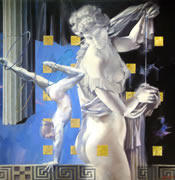
Born in Yugoslavia, educated in Austria, working worldwide from China to the U.S.A. and France, while keeping a main residence in Australia, Charles Billich is a prolific artist and enthusiastic world citizen. It is fitting that his distinguished Primio Pittura 2009 award from the Firenze Biennale originates from Italy, the world’s unofficial spiritual capital of art. Each chapter in Billich’s life seems to be drawn from a saga of many personal paradises lost and found.
The land of Istria, where Charles Billich was born September 6, 1934, has become today as dreamlike and many layered as the artist’s signature paintings of fantastic cityscapes. In the early 20th century, Istria thrived as a small eastern section of Italy, a crossroads of several larger countries. Typically cosmopolitan of their times, the boy’s family members conversed easily in Italian, Venetian, Croatian, and German. The dynamic aesthetic of the day was revolutionized by the new Art Deco style with its Futurist branch. Cultural cross-fertilization was a way of life.

The young boy’s rich world was splintered by, as Billich puts it, “a plot between Roosevelt and Stalin,” when a 1945 U. S.-Russia treaty erased Istria and annexed it alongside neighboring territories into the newly formed Yugoslavia. Now behind the Communist Iron Curtain, Billich’s world became highly restricted and policed, yet Billich continued to pursue his youthful artistic interests. He studied humanities and drawing at the Classical Lyceum, writing articles for unconventional local magazines in his free time. He was accepted by the Rijeka Opera Corp of Ballet that provided an exhilarating dancing career that remains central to his artistic inspiration to this day.
““I still take around the world my inventory of metaphysical choreographic ideas based on ballet. Absurd hyperbolae which include exaggerations on human limits but exclude gravity.” ~ Charles Billich, Millennium Almanac, Billich Gallery; p.9
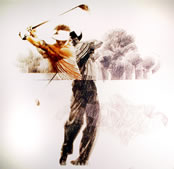
In 1952, when some of his anti-Communist writings came to the police’s attention, Billich attempted to flee to Italy. On the testimony of his girlfriend who turned out to be an informant for the state security service, he was arrested and sentenced to ten years in Maribor prison. Ironically, this difficult time provided him with the invaluable mentorship of many great intellectuals of the day who were fellow political prisoners. From this exalted prison company, Billich learned more languages, art history, the contemplation of spiritual questions, and practical life skills. Recruited to construct scenes for the inmates’ theater, he also began his passionate involvement with the fantasy art of set design.
“I never painted the conditions of that episode… I disliked social realism, which I perceived as an arm of official propaganda.” ~ Charles Billich, Millennium Almanac, Billich Gallery; p.9

After surviving two years of hunger, cold, and sadism, Billich experienced “the finest anecdote of my life… the most irrepressive joy… a sudden, unexpected, outright amnesty” that was engineered by the Red Cross – and Billich was freed from prison. He decided to devote himself to painting and to initiate a new life on the world stage based on the inspirations gained from his introspective prison years. He fled to Salzburg, Austria.
“In this town, perhaps stimulated by its Baroque miracles, picturesque scenes, and urban beauty, I came to feel I had a certain gift, granted by God… I decided upon the life of an artist.” ~ Billich, Billich Foundation; p.6
Long winters and provincialism eventually eroded Billich’s preference for Salzburg as home base. He boarded a ship bound for Australia where he thought a fresh atmosphere would inspire him. Billich passed the fifty days of the sea journey learning English. He arrived in Australia while the Olympics were being held in Melbourne and took a job as a multi-lingual translator for the Ministry of Immigration in Victoria. Art’s persistent sirens lured him away from secure and conventional paths. Billich quit translating and enrolled in the National Gallery Art School where curriculum was based on the Socratic Method which questions each event in order to find lessons for improvement, a process that has stayed with him.
“I never say, ‘Hey that’s fine; that’s a great painting!’ but rather, ‘Where did I go wrong?’ This feeling of doubt always plagues me, forcing me to work as much and as long as possible, in hope of extracting the occasional diamond from so many tons of sludge.” ~ Billich, Billich Foundation; p.6
An opportunity arose for Billich to provide paintings for French film director, Roger Vadim, to use in his film, “Night Games.” Filming took place in Manila, The Philippines, where Billich became absorbed into an exotic society of artists and patrons. His paintings attracted international attention and brought him an invitation to exhibit at the 1983 International Festival of Two Worlds held in Spoleto, Italy. In 1987, his work received the distinguished Spoleto prize.
“My concept of quintessential urban research was born in Spoleto itself, whose city walls contain such extraordinary gems. The secret components and monuments of this city were brought to light and exposed, ignoring the city walls… This manipulation of reality had entered into my blood, and I had begun to treat other larger and more modern cities in the same manner.” ~ Billich, Billich Foundation; p.8
In 1988, Billich was chosen as an official painter of the Bicentennial Commemoration of the establishment of the Australian colony. For research, Billich sailed along the route of the original ships sent from England to found Australia. He had to learn to climb the masts of sailing ships while carrying bundles of painting equipment and be able to paint nautical scenes under rocking ocean conditions. These experiences would add immediacy and veracity to his later paintings of Olympic sailboats and international races.
In 1990, Billich’s path circled back to his birthplace when he worked in Post-Communist Croatia as a guest artist in the atelier, Lotrscak Tower. During the many twists in his journey, Billich had developed his craft, clarified his unique aesthetic view, and become an international citizen. For his skilled celebration of the interrelation of art and athletics, he was selected as the 2000 Sport Artist of the Year by the United States Sports Academy in Alabama. In 2004, Billich’s paintings went on display at the United Nations, New York.
His art works are held in the most illustrious collections and museums around the world, from the Australian Embassy, Japan, and The Royal Collection of Thailand, to the Vatican, “an artist’s heaven.” Billich’s early experience of the tragedy of losing basic freedoms has inspired him to live a rich life to the fullest. He believes that art is a profound ambassador of peace. Describing himself as, “an itinerant artist,” Billich has become a troubadour of contemporary art, travelling the globe, spreading his visions of multi-cultural pollination and harmony along his way.
“Let us appreciate… the freedoms hard won over time, freedom from walls and boundaries but mainly freedom of thought and expression. Let us revisit, update and celebrate our historic diversity and pictorial legacy.” ~ Charles Billich, 2009 Christmas card
Style & Inspiration
Charles Billich – “IL PREMIO PITTORE” – 2000 SPORT ARTIST OF THE YEAR
“There is a touch of irony in what I paint as there is in all Surrealist art.” ~ Charles Billich
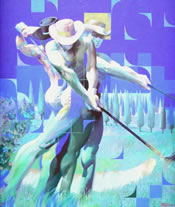
As a travelling minstrel of the healing powers of the visual arts Billich sometimes takes the role of the iconoclastic prankster whose mission it is to shake our assumptions, to make us laugh and cry and celebrate our mixed up world. Billich encourages us to examine civilization through art by painting portraits of complex, conglomerate cities that contain elements ancient, current, and futuristic. These time-lapse images illustrate how a place and our lives in it are made up of every moment of its conceptual and actual existence. Surrealism, a movement founded in the 1920s on the power of fusing waking and dream realities, is the appropriate style for such a pursuit. At the same time, Billich aims to step beyond a single category to present new images uniquely of our age.
“Billich’s break with traditionalism and the avant-garde is truly significant for our age… in collusion neither with tradition, as seen from the European point of view, nor the international avant-garde… Billich’s painting can only be accepted on the level of the present.” ~ Josip Depolo, Art Critic & Art Historian, Millennium Almanac, Billich Gallery; p.1

After the abstract art revolution of the early 20th century, figurative art re-emerged in the late 1900s. With the appearance of conceptualism and renewed popularity of symbolic art at the beginning of the 1980s, the major battle of the avant-garde was lost. In the stage of faddish disintegration, the last lines of its historical chapter were being written. Billich’s urban fantasy images provided an appropriate setting for this operatic saga. He devised multi-faceted portraits of cities busy with people engaged in re-defining contemporary life.
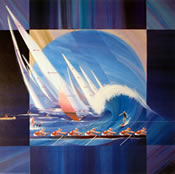
The driving force in Billich’s paintings is the dynamic scope of crumbling and emerging civilizations where any clinging to one static, eternal viewpoint is fatal. Billich paints scenes from the industrial era inhabited by athletes, models, and artists in the process of remodeling the world.
“His taste and need for the ‘beautiful illusion’ is formed on the boulevards of the major cities with luxurious shop windows, that the painter’s erotic sensibility and his experience of women is conditioned by erotic magazines and commercials, that his palette is a mirror reflection of the city lights, the aggressive neon, and theatrical lamps: Billich’s painting is, in short, constructed entirely from our civilization…Billich belongs completely to the ‘new world’…from an acclimatization to a new reality… ” ~ Josip Depolo, Art Critic & Art Historian, Millennium Almanac, Billich Gallery; p.5

Billich draws on his ballet training for imagery to express the combined celebratory pageantry and inescapable fading of every precious moment and civilization.
“Dancing scenes have an isolated and prominent position in Billich’s paintings, not merely because of the painter’s past in the ballet of the Rijeka Theater, but also because of the symbolic meaning the painter gives to the pas de deux of our civilization… Our dancing steps are the equivalent of the unforeseen fate leading us to the moment when all the bright lights will be turned off… on the glittering stage of our civilization… These scenes… belong to the painter’s poetic being and his dramatic vision of Balzac’s human comedy, with which Billich’s painting is also interwoven.” ~ Josip Depolo, Art Critic & Art Historian, Millennium Almanac, Billich Gallery; p.6
Though the artist’s optimism is hard won, Billich perists in his view that the future is glorious and art can be one of our most powerful allies in the struggle.
.“In all his work, (he) continues his rigorous search for the inner meaning of the composition, in all the forms to which he molds it… In a continual movement of stimuli, the emotional tension of Billich’s canvases plunges into compassion, while the heavens shatter into a myriad of tonal harmonies, and space becomes fixed in a metaphysical state… a window opening onto… a tomorrow that is free and full of vitality… He follows the principle that art must satisfy very precise requirements, not the least that of offering strength in the face of life’s tensions and support against the harshness of alienation.” ~ Franca Calzavacca, Millennium Almanac, Billich Gallery; p.7-8
Influences from Cubist and Metaphysical styles are evident in Billich’s works. Both these styles contain elements that further the aims of Surrealists to portray symbolic dream images. In Billich’s masterful series, Bing Mah Yong, created for the 2008 Olympics held in China, the clay figures from ancient Chinese tombs come to life in poses of various sports. These are not ghoulish ghosts back to haunt us but friendly genies out to help us learn in the present from the glories of the past. The same mood transformation is evident in Billich’s cityscapes. The fractured imaginary cities are as impressive and realistic as the unsettling, nightmare streets laid bare by the influential Metaphysical Spanish painter, Giorgio de Chirico. However, they are made happily inspirational by the use of the soft brush strokes, cozy crowding, and warm Mediterranean palette of Cezanne’s Cubist hillside villages.
One of Billich’s key roles in the development of contemporary art is that of reviving and subsequently remaking the place of figurative art as a voice of the present and future. The Abstract painters of the early 20th century wanted to eliminate all recognizable associations from their paintings and convey their messages with pure non-realistic forms. This effort was a negation of representational forms and presented a dominantly negative conceptual tone. Most early industrial era scenes presented cities as breeding grounds for the destruction of society’s humane qualities. Billich resurrected representational form and put it to new use in the service of a positive world view. He believes that within the freedom of possibilities of Post-Modernism, “formal art is the true link between past and future art.”
“Billich’s mysterious and enigmatic ‘city’ suspends the drama of a solitude from which there is no escape, and offers in its place a return to the possibility of reconstructed social relationships in our daily lives, while the bonds are loosened and the robots melt in the sun of humanism redeemed.”~ Franca Calzavacca, Millennium Almanac; p.8
Billich states that “I do what I do because I’m driven,” and that drive comes largely from his desire to correct the chronic ills of society that stifled his early artistic endeavors. He creates new world images in his paintings and sculptures to inspire others to join the quest.
“I try to convey spiritual optimism and vitality; visual utopias. I want people to look higher, as much for their own sake as for the sake of the community.”
Key Sport Works & World Influence
Charles Billich – “IL PREMIO PITTORE” – 2000 SPORT ARTIST OF THE YEAR
-
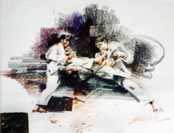
Karate 1987
- Spoleto Award, Italy
- 1988
- Spoleto Prize, Italy
- 1989
- Milan & Spoleto Award, Italy
- 1991
- Parliament House Exhibition, Queens Hall, Melbourne, Australia Hotel de Paris Exhibition, Monte Carlo
-
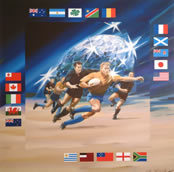
Rugby World Cup 1992
- Misukoshi Gallery Exhibition, Tokyo
- Official Artist, Spring Racing Carnival, Melbourne
- 1993
- Australian Consulate Exhibition, Hong Kong
- 1994
- Museum of Zagreb Exhibition, Croatia
- Gold Coast Arts Center Exhibition
- 1995
- Guest Artist, The Chinese Artists Association, China
-
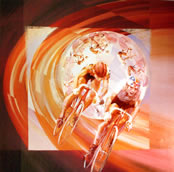
Whirlwind 1996
- Olympic City Exhibition, Atlanta
- Commemorative Centenary Painting, Australian Football League
- Official Artist, Formula 1 Grand Prix, Melbourne
- Official Artist, Australian Olympic Team, XXVI Olympiad
- Official Artist, Sovereign Yacht Races, Australia
- 1998
- Mimara Museum Exhibition, Zagreb
- 2000
- Sports Artist of the Year, United States Sports Academy, Alabama
-

Rugged