Artist archive
Cristóbal Gabarrón
Biography
“The Maestro” – 1992 Sport Artist of the Year
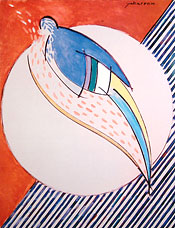
Great artists’ creations can become the voice for the societal struggles into which they are born. It is so with the work of the great Spanish artist, Cristobal Gabarron. The year of his birth, 1945, also marked the ninth year of Francisco Franco’s tyrannical rule of Spain that crushed protests and destroyed all art that contradicted Fascism. Gabarron strived to express in pictures what he was forbidden to say in words: respect for human dignity, right to freedom of expression, appreciation of natural beauty, and the hope that survives even in dark times.
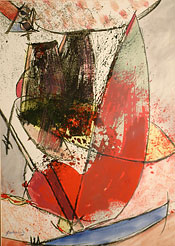
Gabarron’s works have been celebrated in hundreds of expositions, over thirty books, and numerous awards from around the world. His high energy productivity, originality, multi-cultural appeal, and quest for excellence have earned him the admiration of thousands and the title, “Maestro.”
“Gabarron is like the great artists from the Renaissance with his vocation of a universal man, outgoing, whether it is in culture and art from the past, or in the novelties and discoveries of the present.” ~ Erick Oge, Art Critic
Style & Inspiration
Cristóbal Gabarrón – “The Maestro” – 1992 Sport Artist Of The Year

His work is both abstract and representational, often showing a transition between the two that involves the viewer in the process of moving from the literal or corporeal into the symbolic and mystical. A simplified outline of a human body becomes Gabarron’s calligraphy for expressing universal themes. His patterns of dots and lines seem reminiscent of Morse code or hieroglyphics, transmitting the sense that one is looking at a dream language that one could translate with more mental and emotional immersion. The images often seem generic and the symbols multi-cultural to give his work universal social meaning and timeless relevance. His moods and themes are mixed to convey the coexistence and transformations of tragedy and triumph.

Regardless of dimensions, almost all Gabarron art has a monumental feel. This quality communicates the artist’s view of the smallness of humans in relation to contemporary society as well as the immensity of life’s mysteries in relation to what is humanly knowable. His dancing figures and bold colors counterbalance the oppression of the immense obstacles depicted and create an overriding hopefulness and joy in even his most ominous images. Most of his works invite the viewer to enter into the exploration of his monumental themes, either by leading the eye around the painting or by allowing the person physically to walk through his sculptures and consider the elements from many sides.
While Gabarron’s Spanish roots are clear in his symbols, his universal themes have made the work resonate with people everywhere. Gabarron’s sculptures and paintings are displayed worldwide and continue to be a masterful voice for the eternal human issues, dignity, freedom, and joy in creation.
“Everything you can imagine, the result of the relation of man with his surroundings, in his daily life, in his personal fight; man face to face with his manhood and face to face with Nature… And what follows, besides the ambiguity of the approaches, to which all these subjects contribute, is for me a thrilling challenge to which I cannot resist and to which, with absolute certainty I succumb to day by day.” ~ Gabarron, “Whispers in Silence,” p. 240
Cézanne, Cubism & Gabarrón
Paul Cezanne’s white spaces between brush strokes formed a sense of air and transparency, while his constructions of disjointed blocks of color created a sense of weight and mass. Cezanne’s original style blasted all observant artists of his time out of the old visual styles and into the modern era. Cezanne’s work influenced the Fauves and the Cubists and continued to transform all significant art in the early 20th century. His paintings made visible in a unique way the building blocks of objects and spaces and the interaction of planes.
The visual representation of the internal structure of objects and air is peculiarly 20th century in its references to discoveries in physics and chemistry. It places Cezanne (1839-1906) in a revolutionary realm of his own among the artists of the late 1800’s and early 1900’s. Cezanne’s structural elements were very influential on Gabarron’s early Cubist sculptures and on his early paintings. Gabarron added his own surprising element to this mix by fusing biological and inanimate objects into new painterly beings that float and dance through his works like ageless organic robots telling timeless stories about humanity.
“Gabarron has expressed with expertise… a radical way to understand space and time.” ~ Benigo Pendas, Art Writer
Matisse, Fauvism & Gabarrón
The French artist, Henri Matisse (1869-1954), began painting in conventional styles. Then his vision was freed by seeing Cezanne’s Cubist paintings that fractured natural forms into sections of light and color on different planes. Cubism led Matisse to experiment with new combinations of color and form. These explorations eventually led Matisse into the movement of Les Fauves (Wild Beasts), artists who selected paint colors largely for their emotional values. Continuing to invent even into advanced age, a weak and bedridden Matisse found a fresh way to create by cutting paper into large, expressive shapes and arranging them fluidly on canvas. Matisse’s combination of expert training and respect for unpredictable inspiration led to his joyful style that is both simple and sophisticated. It is the abandoned, primitive power of these late works by Matisse whose influence shows so profoundly in much of Gabarron’s work.
Matisse and Gabarron share the ability to create simple images that can communicate complex statements. Matisse said, “I have always tried to hide my efforts and wished my works to have the light joyousness of springtime, which never lets anyone suspect the labors it has cost me.” The intriguing mystery created by this contradictory style is an intentional and significant part of both artists’ greatest works.
DuBuffet, Art Brut & Gabarrón
Jean Dubuffet’s Art Brut or Raw Art style strives for vitality and expressiveness through combinations of unexpected media and creative input free of conventional academic restrictions. Dubuffet (1901-1985) collected art by inmates of mental asylums. He posited that mainstream culture assimilates each new development so that genuine expression is smothered. Only Art Brut can speak with pure creativity from those who remain untrained and unassimilated. Dubuffet valued Art Brut as evidence of humankind’s innate creative drive.
“Those works created from solitude and from pure and authentic creative impulses – where the worries of competition, acclaim and social promotion do not interfere – are, because of these very facts, more precious than the productions of professionals. After a certain familiarity with these flourishings of an exalted feverishness, lived so fully and so intensely by their authors, we cannot avoid the feeling that in relation to these works, cultural art in its entirety appears to be the game of a futile society, a fallacious parade.” ~ Jean Dubuffet; “Make Way for Incivism;” Art and Text #27 (Dec. 1987 – Feb. ‘88); p. 36.
Dubuffet’s early paintings make striking use of areas of muddy smudges reflective of primordial moss and ooze in keeping with his respect for primitive states. Later works, such as his sculptures in the Hourloupe series, express these sentiments more geometrically in cartoon-like doodles with strong outlines that suggest puzzles. Created between 1969 and 1971, in Dubuffet’s Hourloupe series, the “Monument au Fantome” sculpture (Houston, Texas) has seven main elements made of painted fiberglass over stainless steel armature. It shows many stylistic elements in common with Gabarron’s.
In the 1970’s, the term, Outsider Art was coined to include pure Art Brut plus creations by any self-taught artist working outside the mainstream in naïve and fantasy-inspired styles. Gabarron’s work shows strong influences from Dubuffet’s Art Brut style and spirit. Gabarron’s early series, “Coleccion Lobo” is dominated by the dark smudges and primitive images characteristic of early Dubuffet paintings. Gabarron’s later works evolve into more joyful, colorful and monumental forms yet still evoke a sense of mystery and primitive power, as shown in his sculpture series, “Twelve European Muses,“ and in his impassioned statement that, “The main task that I confront daily in my studio is that of working with honesty.” (Urban Landscapes, p.17)
Key Sport Works & World Influence
Cristóbal Gabarrón – “The Maestro” – 1992 Sport Artist of the Year
“My philosophy is based on constant effort and always moving forward.” ~ Cristóbal Gabarrón, “Urban Landscapes”
-
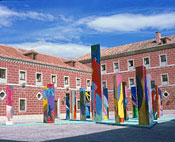
Atlanta Star 1945
- Born in the town of Mula, Murcia region, Spain
- 1964
- Begins creating art based on natural images from his native Castile landscape
- 1965
- Transitions from representational to more abstract style
- 1990-92
- “History of Olympism” – world’s largest mural; Barcelona, Spain baseball stadium
-
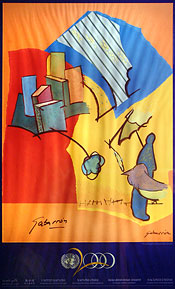
United Nations 2000 Poster 1992
- The Gabarron Foundation for inter-cultural projects; main offices, Valladolid & New York
Awarded USSA Sports Artist of the Year & honorary doctorate; Daphne, Alabama
Seville Expo mural of Columbus’ voyage to America & Seville’s multi-cultural heritage - 1993
- Commissioned by USSA for art work representing 1996 Games of the XXVI Olympiad
- 1996
- “Atlanta Star” sculpture installed at Games of the XXVI Olympiad, Atlanta
- 1997
- “Tribute to Human Spirit” United States Sports Academy mural, Jackie Robinson breaking baseball’s race barrier
-
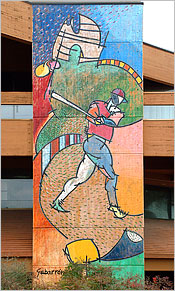
A Tribute to the Human Spirit 2005
- “The Body Image in Cristóbal Gabarrón’s Art;” exhibit, Chelsea Art Museum, New York
“Each one of the works of art that make up a series are, for me, fragments of the same subject, the chapters of a novel.” ~ Gabarrón, “Whispers in Silence,” p.256
A Tribute to the Human Spirit
The largest public art offering in the state of Alabama, the famed two story tall mural by Gabarrón entitled, “Tribute to Human Spirit,” graces one wall of the main USSA campus and has become a landmark on Mobile Bay’s Eastern Shore. In celebration of the Academy’s 25th anniversary, the mural is dedicated to the 50th anniversary of Jackie Robinson breaking the color barrier in professional baseball.
“Blending sport with culture and education, Olympism seeks to create a way of life based on the joy found in effort, the educational value of a good example and respect for universal, fundamental, ethical principles.” ~ Olympic Charter
“A Tribute to the Human Spirit” — An Interpretation
To commemorate the United States Sports Academy’s 25th anniversary, the renowned Spanish artist, Cristóbal Gabarrón has generously endowed the institution with one of the world’s great sport murals. The creator spent many months researching and developing his concept while in residence in Madrid.
With this work Gabarrón presents a definitive tribute to the allusive spirit of mankind, a spirit so highly exemplified by the athletic achievements of Jackie Robinson.
The mural itself portrays those most exalted and universal values found in sport: dedication, sacrifice, solidarity, teamwork, friendship… all of which contribute to the common goal of success. These treasured values represent and are required to attain the personal as well as the collective rewards every player yearns for.
It must be taken into consideration that the artist’s message is contained and somewhat confined by limitations held on a concrete wall four times as high as it is wide. Given those constraints, the artist constructed his visual statement in a powerful flow of verticality anchored down by the central image of a baseball player confronted by the crucial moment of initiating his swing at the ball. Furthermore, the artist has heightened the implied motion by lacing curved lines through a dynamic corridor of space that ball, bat and batter will follow.
Three essential elements – the helmet, the bat and home plate – connect, though not directly, touching one another to form a vertical axis. The dark, curving lines revolve around the elements to form an interpersonal assimilation of design. In turn, the central form is both supported and surrounded by the play of color hung throughout the rotational exhibition of force.
The mural can be evaluated and understood by unveiling the two interwoven levels of meaning contained within. The first of these is clearly the figure of a “man.” The overt simplification expresses the prowess of the human figure. The second is the “spirit,” which transposes the event by enveloping the act of the athlete. This implied union of static and kinetic force finds a complete and graceful form of development throughout the mid-panel of the mural.
The general structure of the work revolves around a series of symbolic images that become interrelated through the diverse use of color, tone and line. The linking of these elements throughout the mural creates a characterized statement about the physical and moral purpose of sport, those reflected by the Olympic creed – opportunity, equality and fair play. Religious, racial, cultural and ideological differences bow before this shared spirit. The single power that ensues fills the heart and soul of every player who enters the game.
Gabarrón has given special importance to the moment in which the player brings the bat into contact with the ball. The fractioned instant whereby the athlete shifts his weight over his center of gravity and floats atop his cleats is encapsulated by the array of color clustered around the act. This transfer of energy continues outward along the curving lines toward the bases.
The face of the athlete carries special connotations. It is a face without identity, divided between marked areas of black and white. Such delineation brought together on the profile of an athlete exhibits the promise of racial harmony that sport provides.
The larger silhouette found behind the central figure falls between the tonal shadows of sky and earth. The upper region, filled with rich blues, forms the expansive sky, the heavens which watch over the stadium lights. The sky falls to reach the fields, acting as the common uniform all players wear. Filled with the heat of the game, the energized atoms vibrate within the stadium walls. The physical and emotional heat of the game is portrayed through hundreds of vibrant strokes of color as if it were a festival of humanity that has invaded the stadium.
The hidden figure in silhouette represents that “larger than life” spirit. The upper silver area represents the catcher’s face mask. In one sense the mask provides protection from the impact of a foul ball. However, it also entraps the person behind it, not unlike imposed prejudice from which he so desires to escape. On the left portion of the mural the swing of the bat projects its passing power. The swing is an aggressive act conducted to advance the player’s dreams of glory.
Finally, the coloration on the sides is a personal comment for the brotherhood of two nations, the artist’s homeland of Spain and the United States, the recipient of the art work. From an artist of deep Spanish convictions, this mural is dedicated to an athlete with great southern pride and a symbol of even greater American prosperity: Jackie Robinson.