Artist archive
Donald Moss
Biography
“Premier Sports Illustrator” – 1985 Sport Artist of the Year

On 7 August 1942, Donald Moss, a Corporal with E. Co. 2nd Battalion, 1st Marines, landed on the island of Guadalcanal where he fought in “The Battle of Tenaru,” the first major ground battle during the Pacific Campaign in World War II. After winning commendations both on Guadalcanal and The New Britain Campaigns, Moss finished up his career in the USMC on the Island of Guam. On 15 August 1945, Marine Corporal Donald Moss received first prize in Guam’s Art Exhibition for his work, “Marine Still Life.” Moss was given the blue ribbon by his friend, 1st Lt. USMC Tyrone Power, signaling the beginning of many awards and recognition for his art yet to come.

Growing up in Melrose, Mass., a small city seven miles north of Boston, Moss played sandlot baseball, hockey, and tennis. He spent summers traveling New England in search of every golf course he could play. His affection for natural beauty and sport manifested in posters he designed in high school and earned him a scholarship to Vesper George, a then prominent art school in Boston. Moss’ subsequent lifetime collection of art spans a wide range of artistic media utilizing oil, acrylic, tempera, watercolor and enamel for his representations of dramatic sports moments, places and figures.
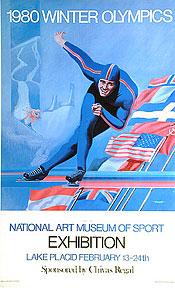
After four years with the Marines, Donald Moss returned from World War II ready to work and eager to paint. He moved to New York where he attended Pratt Institute and began work as a freelance artist and designer for magazines and ad agencies such as Colliers and Esquire. His work is recognized by tennis players, skiers, golfers, car enthusiasts, and many who watch television. His accomplishments include trademarks and logos for AMF/Head racquets, Olin Skis, the American Broadcasting Company (ABC), and Mercedes-Benz. In 1978, Moss was commissioned to design the official poster for Super Bowl XII. Six million prints of the poster design were distributed nationwide bearing his name. His work has been commissioned by, among others, Arnold Palmer Enterprises, Golf Digest and Sports Illustrated.
Moss has maintained an amicable relationship with friend and fellow Marine, Dr. T. P. Rosandich. His contributions to the American Sport Art Museum and Archives (ASAMA) and the United States Sports Academy include a number of paintings, prints, and posters. True to the mission of ASAMA, students and visitors to the Daphne, Ala., campus are welcome to become part of Moss’ artwork. Moss said,
“I want to bring out the life in the scene so that a golfer or an observer who has seen the course or the event can look at the painting and mentally put himself there. I know I’ve been successful when the viewer says, ‘I was there, and I can appreciate that painting.’”
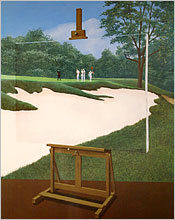
But even a viewer who has not seen firsthand the famed 13th hole at Augusta or the 14th at Mahogany Run in the US Virgin Islands—both available for viewing in the ASAMA collection—can appreciate the affectionate splendor of Moss’ painted interpretations of them.
After a unanimous vote to select Moss as 1985 Sport Artist of the Year, Academy President and CEO Dr. Thomas P. Rosandich wrote,
“All of us are overwhelmed by the great spectrum of his art, from the abstracts on the Sports Illustrated cover, to the quiet stillness of a hunting scene, and all skiing and golf in between, let alone twelve commemorative stamps.”
Donald Moss was recognized for his achievements on 25 April 1986 at a black tie event at the Riverview Plaza in Mobile, Ala. In a tuxedo with an Academy pin on his lapel, Moss mingled with national and Mobile elite at the $100 per plate sit-down dinner.
Style & Inspiration
Donald Moss – “Premier Sports Illustrator” – 1985 Sport Artist of the Year

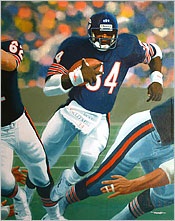
Moss’ work has been called “romantic,” “versatile” and “dramatic.” “I constantly strive to render the drama of sport in my art,” Moss said. “To have a great painting—particularly in sport art—you must get that incredible intensity of the athlete’s expression. That’s what I try to capture.” Perhaps no better painting demonstrates Moss’ philosophy than the oil painting of “Sweetness,” depicting Walter Payton, the Academy’s 1985 Male Athlete of the Year, featured in the Academy’s Sport Artist of the Year Hall of Fame. In the painting, Payton is deftly dodging the opposing team, and beneath the shadow of his helmet, one can see the intensity on his face and the wide-open alertness in his eyes. In addition to his prolific contributions to the art world, it is the ability to capture these kinds of emotions, this instantaneous mixture of movement and intensity not attainable by photograph, that make Moss’ art both accessible and significant. As part of the extensive ASAMA collection, students and visitors will forever be reminded of the interrelationship between the discipline, creativity, and hard work required for academics, sport, and art as demonstrated by the artwork of 1985 Sport Artist of the Year, Donald Moss.

Moss was assigned to paint surreal paintings of professional golfers putting for Sports Illustrated. With this technique, he forced the juxtaposition of the usual and unusual. He heard golfer Lee Trevino say, “Sometimes I come apart when I putt,” and Moss used surrealism to illustrate a literal representation of the metaphor. In the painting, Trevino appears to be literally coming apart. In a surreal painting of Jack Nicklaus, the golfer is surrounded by flag pins and holes, every one of them with a sunken golf ball. “Jack Nicklaus could make anything,” Moss said. While he interpreted the reputations and sayings of the golfers for his surreal paintings, Moss also believed in the dream-like qualities of the style. “Sometimes you paint things and you really won’t have a definite reason,” he said.
For 30 years, beginning one month after the initial launch of Sports Illustrated, until his final cover art on 12 November 1984, Moss was the magazine’s premier illustrator. Moss painted more covers and editorial illustrations for that magazine than any American painter. A devoted skier, Moss skied the trails he painted for Sports Illustrated, often from the racer’s point of view or from mountain aerials. Because Sports Illustrated art director Dick Gangel liked for his artists to experience their assignments, Moss was exposed to a variety of sports experiences. In addition to skiing, Moss played many rounds of golf for his renowned “Best 18 Golf Holes in America,” and photographed sports greats like tennis player Jimmy Connors, professional baseball players, and famous NHL stars on ice for his acrylic series. He notably spent from early morning to late afternoon taking hundreds of photographs of his subjects at all conceivable angles. He admitted to sometimes working 14 or 15 hours in a day.
“I immerse myself in research,” Moss said.

The piece for Sports Illustrated that Moss felt most emotionally attached to was also his first cover, from the Kentucky Derby, published on 4 May 1964. The cover is done in trompe l’oeil style, creating the optical illusion that the object of the painting, in this case a flyer for the Kentucky Derby posted on a wooden planked surface, is in 3D. At Sports Illustrated, Moss was afforded the opportunity to experiment with other artistic techniques. His meticulously honest illustrations of everyday life suggest influences of the artistic movement of realism. Influenced by French Impressionist painter Cherot, Moss’ other works employ a phenomenon that relies on a viewer’s perception to distinguish a familiar image from a series of colors in a technique known as pointillism. In tune with the art trends of the 1950s, Moss also exploited the context of familiar commercial images, specifically baseball players, consistent with the artistic style of pop art. Inspired by Magritte, a surrealist painter and innovator, Moss used surrealism to “catch something that cannot be photographed,” or the emotional truths of the sporting moment. “Surrealism is very cerebral,” Moss said. “It gets inside you.”
Key Sport Works & World Influence
Donald Moss – “Premier Sports Illustrator” – 1985 Sport Artist of the Year
Moss’ paintings are featured in The Best of Sports Illustrated, many museums, and the baseball, basketball, and tennis halls of fame as well as USGA’s Golf House. He was invited to the White House by President Ronald Reagan for the opening of the Smithsonian’s “Champions of American Sport Exhibition,” which featured his paintings of Ted Williams and Jack Nicklaus. The inclusion of the Williams painting in the Smithsonian’s 200 Years of Sport in America ensured that, as Joanne Price wrote, “The ear splitting crack of Ted Williams’ bat forever resonates in the crackling rainbow of color.”
Later, as Chairman of the United States Air Force (USAF) Art Program, Moss flew around the world and painted USAF activities. Those paintings are now displayed in the USAF art collection. Moss also authored and illustrated The Art of Watercolor Painting (Walter Brooks, 1975). He has designed a dozen commemorative stamps for the United States Postal Service including one for the “50th Anniversary of Tennis” and was selected as an illustrator for the 1980 XIII Olympic Winter Games in Lake Placid, N.Y. for which he also created stamps. The mascot for the Games was commissioned as an animal. Moss “decided it should be a raccoon because of the unique mask-like appearance of his eyes which would be great for the Winter Olympics.” The masked mascot was then named “Ronnie the Raccoon” by school children of Lake Placid, and Ronnie’s distinctive face graced many Winter Games posters and accessories.
Moss said, “I have always been impressed by athletes who give everything to their sport. I admire their intensity, their ability to please others and make a good living at the same time. As a sports painter, I like to think that I do the same.” Thus, Moss became deeply involved in art with affiliations with several prominent committees and memberships. He served as Senior Vice President and lifelong member of the Society of Illustrators. He has also been a board member of the National Art Museum of Sport, a member of the Low Illustration Committee of the New Britain Museum of Art, and a member of the First Marine Division Association. For his entire art career, Moss continued to work on his craft, always striving to improve. “Just like a tennis player tries to get stronger or a runner tries to go a little faster, an artist is always trying to do better,” he said. “It keeps you competitive and keeps you alive.” This dedication, hard work, and high achievement contributed to the selection of Moss as the 1985 Sport Artist of the Year.