Artist archive
Ernie Barnes
Biography
“America’s El Greco” – 1984 & 2004 Sport Artist of the Year
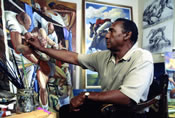
Barnes working on ‘Boxing’
No more appropriate contemporary artist than the late Ernie Barnes could have been honored twice as the first Sport Artist of the Year in 1984 and again in 2004 as the 20th Anniversary selection. The critically acclaimed Neo-Mannerist painter masterfully captured the passion and elegance of sport in his paintings throughout his impressive 43-year career. Barnes drew artistic inspiration from all facets of his complex life, from childhood through adulthood and his celebrated football career. No matter what his activity, all directions pointed to art as the core of his identity.
“Throughout my five seasons in the arena of professional football, I remained at the deepest level of my being—an artist.” ~ Ernie Barnes

Sunday’s Hero
Barnes’ 1995 autobiography, From Pads to Palette, shows him as an introspective artist and an eloquent writer. In the Forward, Jack Kemp, former San Diego Chargers quarterback and Ernie’s teammate, says:
“He has become a beacon of hope, shining from the inner-city streets and the dirt playgrounds of rural North Carolina… a manifestation of the American Dream… Ernie’s art helps play a very positive role in uplifting… our nation.”
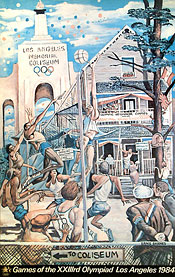
Volleyball: 1984 Olympics
Ernest Eugene Barnes Jr. was born in Durham, North Carolina on July 15, 1938. The country was recovering from the depression, but war was looming in Europe. Race relations were unstable, and Jim Crow laws still mandated the segregation of blacks and whites. His father worked as a shipping clerk for Liggett Myers Tobacco Company. Ernest Barnes, Sr. would return from long, tiring days to his home on a dirt road in “the bottom,” a poor section of Durham, to play some Scott Joplin ragtime on the piano and then fall to sleep reading the paper. Ernie, his older half-brother, Benny Rogers, and his younger brother, James, passed the time drawing designs with sticks in the wet Carolina dirt. Their mother, Fannie Mae Geer, had bigger plans. She was determined to make possible education and cultural enrichment for her children.
Barnes’ mother initiated his exposure to world culture by taking Ernie to the house where she worked as a domestic to meet her employer, Frank Fuller Jr., a wealthy attorney. In Fuller’s study, Barnes was introduced to fine art. “I enjoyed this room of polished, mahogany walls with leather chairs, shelves of leather-bound books and the sound of classical music.” Fuller recognized Barnes’ affinity for art and would tell him “about the various schools of art, his favorite painters, the museums he visited and other things my mind couldn’t quite comprehend at the age of seven.” By the first grade, Barnes had been exposed to the masterpieces of Toulouse-Lautrec, Delacroix, Rubens, and Michelangelo.
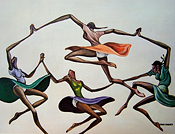
Ring Around the Rosie
Barnes credits his mother not only with guiding him toward formal scholastic education but also with being the source of his internal psychological balance that gave him the scope to excel as an artist. Time and time again, Barnes names emotional insight as the key to artistic greatness.
“I am convinced that my sense of homecoming in the company of women dates back to my mother’s compassion and tenderness which transmitted to her children. Through the years of my pro career, I acquired a patina of hardness and brute strength. A certain callousness. But this always fell away in the easy ambience of women. They kept alive in me the one essential quality no artist can be without – sensitivity. Receptiveness not only to color and light, but to the underlying spiritual messages those elements convey… You must be able to receive those poignant insights before they can be expressed in art. It’s a basic to the creative life.”
Ernie Barnes, “ ~ From Pads to Palette”
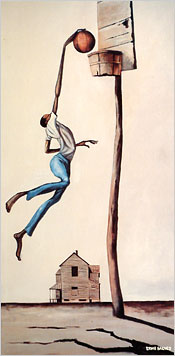
High Aspirations
As a young boy, Barnes did not have an easy time with his sensitivity. He was overweight, mercilessly teased, and beaten by his classmates. Barnes turned to his sketch books for sanctuary. “When I was at home and drawing,” Barnes wrote, “I was happy… I made friends with lines.” At adolescence, he became interested in girls and realized that one of the best ways to gain their admiration was through athletics. Barnes signed up for the football team. He didn’t enjoy the physical violence of the sport, but his mother knew that it would help him advance in society and insisted that he continue.
Throughout his school days, Barnes often stole away by himself to draw in his sketchbook. His secret occupation was discovered by Mr. Tucker, the high school’s masonry shop teacher. Instead of reporting Barnes to the principal’s office, Tucker questioned him on his life goals. Tucker encouraged Barnes to begin weight training. Barnes followed Tucker’s program with devotion and, by his senior year, sweated his way to captain of the varsity football team and state champion in the shot-put. By graduation, Barnes had received 26 scholarship offers from colleges and universities. This outpouring was Barnes’ ticket to an education that otherwise he might not have been able to afford. None of these offers came from Duke University or from the University of North Carolina, both only miles from his home. Barnes graduated from Hillside High in 1956, well before anti-discrimination laws were widely enforced. The struggle for racial equality played a pivotal role in the forming of Barnes’ identity and in his development as an artist.

The Maestro
Barnes spent four years at the all-black North Carolina College, today known as North Carolina Central University, majoring in art. Aside from playing football, Barnes studied with chairman of the art department, Ed Wilson, and co-chairman, William B. Fletcher. Under these two artists, Barnes learned the fundamentals of drawing, painting, anatomy, structure, drapery, perspective, light and shade, sculpture, design, figure study and art history. Ed Wilson pushed Barnes to find himself in his art, to utilize his experiences and pay attention to what was going on around him. Barnes said that because of Wilson he “came to better understand the art process and the athletic process as being parts of one entity.” In search of psychological truths for the themes of his work, Barnes began transferring his visual and emotional experiences on the football field to his canvases. The power from this fusion of brute force and grace became the foundation for his greatest works.
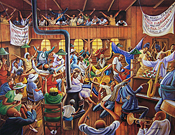
Solid Rock Congregation
While at North Carolina College, Barnes was able to visit the North Carolina Museum of Art in Raleigh where he viewed the work of Rubens, Caravaggio and Van Gogh. After asking the museum tour guide “Where are the paintings by Negro artists?” and getting the response, “I’m afraid your people don’t express themselves this way,” Barnes came face to face with the adversity he would have to overcome as a black artist. Ed Wilson discounted the tour guide’s ignorance after the trip by showing Barnes and his classmates the works of black artists Henry O. Tanner, Edmonia Lewis, Duncanson, Archibald Motley, Hale Woodruff, Sargent Johnson, and Palmer Hayden. At that time, letters from professional football teams started pouring into his mailbox, and Barnes sold his first painting, “Slow Dance,” to Sam Jones of the Boston Celtics for $90.
At 21 years-old, Ernie Barnes was the tenth round draft choice for the Baltimore Colts. After being invited along with his college coach to see the Colts play the Giants in a championship game and to enjoy his first hotel experience, Barnes signed a $6,500 per year contract, with a $500 signing bonus. Based on his experience at the game, Barnes painted “The Bench,” which won him an interview with a news reporter whose article dubbed him “Ernie” Barnes. For the next five years Barnes played professional football for the San Diego Chargers and the Denver Broncos. Now a 6’3” 250-pound guard, he held his own on the football field. Even in uniform, he continued his art. Barnes kept a pencil in his sock to take notes in down time. His teammates called him “Big Rembrandt.” During his time with the Chargers, Barnes was commissioned to draw his teammates for the game programs. Barnes sketched during practices and meetings and was once fined by Denver head coach Jack Faulkner for sketching while watching game film.
“I have always analyzed myself strictly and strongly felt the need to feel centered; to feel self. Part of me was in search of its complimentary half, and the illusiveness of that anonymous being was causing me seriously to think about the legitimacy of my wasting more time playing football… I disliked the fact that I had been clinging to the game and to a weak team because I was driven to being good and I didn’t know how to stop proving that I was.” ~ Ernie Barnes, “Pads to Palette” (p. 76)
His football career led to Barnes’ first art exhibition. The Bronco Backers Club asked Barnes to display his work at a Club party. When a man asked how much Barnes wanted for his painting “The Bench,” Barnes threw out the number $25,000, not wanting to part with the painting. The man wrote a check and handed it to Barnes. Barnes then refused to take it. The bartering drew a small crowd, and in that crowd was a reporter from Sports Illustrated Magazine. The reporter wrote about it and published a photo of “The Bench,” thus catapulting Barnes, as a football player-artist, into the national spotlight. In addition, the Denver Post ran a four-page article on Barnes’ work, garnering him the attention that allowed Barnes to supplement his football income with the sale of clown paintings on cork panel. As he continued to search for emotional truths in his sport paintings, Barnes “began distorting and elongating the proportions, trying to relate what it felt like within the context of a certain movement,” resulting in the characteristic elongation and disproportionate space in what came to be known as Neo-Mannerism.
After joining the Saskatchewan Roughriders football team in Canada, Barnes fractured his ankle. He ended his active football career at the age of 26, but the experiences remained a lifelong part of his artistic inspiration. Barnes borrowed money from friends and pawned two prized patches and a ring in order to move himself and his then pregnant second wife, Janet, into a dilapidated Hollywood motel. There, Barnes walked six miles to the Hilton Hotel Corporation in Beverly Hills to propose to hotelier Barron Hilton that Barnes be made the Official Artist for the American Football League (AFL). Hilton loved the idea, encouraged Barnes to make the proposal to team owners, and commissioned Barnes at $1,000 to paint a portrait of Lance Alworth. The owner of the New York Jets, Sonny Werblin, invited Barnes to New York. Werblin had three art critics assess Barnes’ work, then offered Barnes $14,500—$1,000 more than he made in his last season of football—to paint 30 paintings over the next six months. Ernie Barnes, the artist, was launched.
Style & Inspiration
Ernie Barnes – “AMERICA’S EL GRECO” – 1984 & 2004 SPORT ARTIST OF THE YEAR
“Space is perceived in the imagination…light is incandescent, fitful and unreal … figures are elongated, energized and dematerialized. All are illuminated and quickened by God’s Grace.”
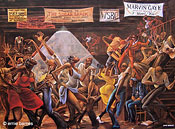
The Sugar Shack
Anyone who has had the pleasure and privilege of viewing Ernie Barnes’ works knows that this could be a fitting description of the style and sources of the power of his paintings. Instead, it is a comment by art critic David Davies on the masterpieces of the Greek artist El Greco who painted four centuries before Barnes was born. Barnes’ and El Greco’s works share both surface style and deep spiritual inspiration. Barnes described the transfer of energy from physical sport to intellectual art in his autobiography.
“I learned to balance my aggressive instincts within creatively by absorbing them into my expressions of movement through the contortions of the body. My mind was intensely active.” ~ “From Pads to Palette”

The Dream Unfolds
Barnes wanted to make a unique statement about 20th century American life. He was not concerned about appearing in sync with his contemporaries. Barnes took a technique from tumultuous Spanish history and molded it to communicate particularly American social struggles. His Neo-Mannerist style of painting suits his timeless spiritual themes and places the works in their proper historic lineage. Barnes says about his goals: “For me, becoming an artist was not an external compulsion but obedience to an inner need to become spiritually intelligent, to ask the ultimate questions about life, and to experience simultaneously the seamless connection between each of us.”

Coffee Break Pause Café
Barnes’ stylistic inspirations came from Europe’s El Greco and Tintoretto, as well as American originals like Charles White, Archibald Motley, and Thomas Hart Benton. His sport and art influences continually overlapped. During a game against the Chiefs in Kansas City, Barnes knocked down a player.“Getting up, I saw a little old man sketching behind their bench… He looked up from his sketch pad… the little old man was Thomas Hart Benton.” Barnes painted many different subjects, including many well known sports highlights. As El Greco’s work inspired Barnes, Barnes’ work ignites future artists. Though Barnes passed on in 2009, his spirit continues to energize all who view his work and urge us toward compassion, creativity, and striving for social betterment.
“When I do sports themes, I can approach them from many levels. The dedication, the discipline, the attitude you have to bring… I can project what it is like to be an athlete… It is my job and personal dedication to restore us to some of the wonders brought by the endurance of the human spirit.” ~ Ernie Barnes, “Pads to Palette”
Key Sport Works & World Influence
ERNIE BARNES – “AMERICA’S EL GRECO” – 1984 & 2004 SPORT ARTIST OF THE YEAR
“No more football for you, young man. Those three… art critics… said that you are the most expressive painter of sports since George Bellows. You’re an artist.”
Sonny Werblin, “ ~ Pads to Palette”
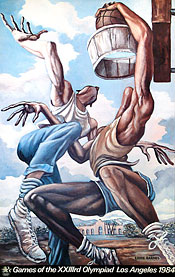
Basketball: 1984 Olympics
In 1966, Sonny Werblin, owner of the New York Jets, set up Barnes’ first solo exhibition, “From Pads to Palette,” at the Grand Central Art Galleries in New York City. The debut was a sellout. Barnes’ fame grew exponentially. The distinguished director of the Grand Central Art Galleries, Erwin S. Barrie, explained what good fortune Barnes had in acquiring Werblin as his patron. “That’s the way it should be. Once a man rises to a certain state of wealth it’s expected of him to make a contribution to the culture of his country. You could turn out to be his best.” (“Pads to Palette”)

Victory in Overtime
Barne’s solo exhibition, “The Sports Art of Ernie Barnes,” in 1968 introduced his art to the McKenzie Gallery in Los Angeles. His solo work would return to that gallery the following year in an event hosted by actor Charlton Heston, and another event in the year after that hosted by journalist, novelist, and screenwriter Adela Rogers St. John. His exhibitions then brought his work to Elizabeth City State University in North Carolina. In 1972 Barnes began a national tour titled “The Beauty of the Ghetto,” which lasted until 1990, taking his artwork from the Heritage Gallery and the California Science and Industry Museum in Los Angeles to his alma mater’s North Carolina Central University Art Museum, to the Museum of African Art in Washington D.C., to the North Carolina Museum of Art in Raleigh among other prominent venues. From 1974 to 1979 his artwork was featured on the CBS primetime TV series, “Good Times,” and in 1976 his painting “Sugar Shack” caught the eye of Marvin Gaye, who used the painting for the cover art on his album, “I Want You.” Barnes’ recognition as a significant sport artist led to his being named the Official Sports Artist of the 1984 XXIII Olympiad in Los Angeles, and acquired the attention of the United States Sports Academy’s founder, President, and CEO Dr. Thomas P. Rosandich, who named Ernie Barnes the academy’s first Sport Artist of the Year.
1984 Sport Artist of the Year

The Bench
The Games of the 1984 XXIII Olympiad in Los Angeles, California saw Carl Lewis match Jesse Owens’ four gold medals in the 100m, 200m, 4x100m relay, and long jump events. The 400m hurdles were the setting for the first woman from an Islamic nation, Nawal El Moutawakel of Morocco, to win a gold medal. Gabrielle Andersen-Schiess of Switzerland epitomized perseverance when she fell across the finish line in a dramatic ending to the women’s marathon. Amidst these historical athletic accomplishments, the XXIII Olympiad was also the inspiration for five original paintings by appointed Official Sports Artist for the Games of the XXIII Olympiad Ernie Barnes, the 1984 Sport Artist of the Year.
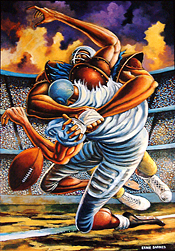
The Sack
In 1984 the American Sport Art Museum and Archives (ASAMA) was founded on the campus of the then 12-year old academic institution, the United States Sports Academy. On 16 March 1985 at the Mobile Hilton in Mobile, Alabama, ASAMA in conjunction with the United States Sports Academy awarded its first ever Sport Artist of the Year Award to Ernie Barnes. Selecting Barnes as the inaugural recipient of the award was practically a given. Peter V. Ueberroth of the Los Angeles Olympic Organizing Committee (LAOOC) had called Barnes’ Olympic posters portraits of “the ethnic diversity of Los Angeles, the power and emotion of sports competition, the singleness of purpose, and the hopes that go into the making of athletes.” It was these attributes of Barnes’ work that made him the ideal candidate for the first Sport Artist of the Year Award. Since its inception, ASAMA has “recognized the importance of the cultural connectivity of athletic competition and artistic expression,” and thus quickly identified the significance of Barnes’ sports art. In correspondence years later, Barnes would recognize the artistic vision of Academy President and CEO Dr. Thomas P. Rosandich. Barnes wrote that it was Dr. Thomas P. Rosandich’s “goal of establishing art at the highest aesthetic level in the Gulf Coast” that made the museum and the award possible.
Head Over Heels
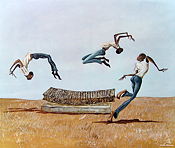
Created to be given “to an individual who captures the spirit and life of sport so that future generations can relive the drama of today’s competition,” the 1984 Sport Artist of the Year Award was a meaningful achievement for Barnes as a painter. But the implications of the award reached beyond the surface of the canvas. In addition to being a master painter, Barnes was also a grassroots philosopher. His humanist views shine through the colors of his artwork. His compassion for others was something he wanted to convey through his art. “The impact of sports resides in our ability as fans to identify with the athlete who is striving against his limitations. The lesson lies in being able to apply to our lives the same dedication,” Barnes said. “Sports are much more than just sporting events. They can be applied to our lives as a spiritual celebration, and this is what I hope to convey in my paintings.” Barnes’ ability to capture emotional truths in his paintings made him even more of the exemplary candidate, and the Sport Artist of the Year Award became more than recognition of the aesthetics of his work. The award was also a tangible acknowledgment of his message.

Boxing Gym
For the next 20 years after being named Sport Artist of the Year, Ernie Barnes continued a successful and prolific career in art, making him one of the few American artists to make a substantial living by painting. He was commissioned to produce a painting for the 1987 World Champion Los Angeles Lakers basketball team, actor Sylvester Stallone, Seton Hall University, St. Benedict’s Prep School in Newark, New Jersey, the Carolina Panthers football team founders Jerry and Rosalind Richardson, the National Basketball association, actor Will Smith, boxer Oscar De La Hoya, and musician Kanye West. The major commissions were in addition to several exhibitions and donated paintings. Ernie Barnes’ reputation continued to swell. His art has been called, “poetic,” “commanding,” a “reflector of American society,” at the “forefront of contemporary visual art,” and a “must have” for athletic art collectors. Art critic Frank Getlein said of Barnes’ art, “All these motions, all these bodies, all these colors and shapes, become, for a moment, ourselves. Art cannot give us more.”
2004 Sport Artist of the Year
Meeting the Challenge
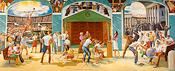
In 2004, as Barnes’ reputation continued to grow, President and CEO of the United States Sports Academy Dr. Thomas P. Rosandich looked back on the 20 years of Sport Artists of the Year and recognized that “no other living American artist has done more to illuminate the world of the athlete and the drama of sports competition as this former athlete and world-renowned painter.” The Academy’s board named Barnes “America’s Best Painter of Sports.” Barnes’ painting “Olympic Finish” was considered for the International Olympic Committee’s art competition, and was later donated to ASAMA. In addition, Barnes was given the honor of the “Order of the Eagle Exemplar” and named 2004 Co-Sport Artist of the Year. Dr. Thomas P. Rosandich said, “Both the Museum and the Academy believe this recognition of Ernie Barnes’ extraordinary contributions to elevating sports imagery to the level of fine art is long overdue.” Presenting the award at an event honoring Barnes in Los Angeles, California, Dr. Thomas P. Rosandich added, “Through his masterly command of line and composition, his characteristic depiction of human anatomy using elongation and distortion, and his origination of the analyzed moment to portray athletes in delayed motion, Ernie Barnes has given sports fans everywhere a window into the agony and ecstasy, as well as the hopes and dreams, of the quest for physical greatness.”
Ernie Barnes passed away on 27 April 2009. Barnes lives on in the memories of those who knew him and those who continue to be moved by his story and his art. The “deepest level of his being,” the artist, will forever reside in many private collections around the world.