Artist archive
Hans Erni
Biography
Architect of Athletic Achievement – 1988 Sport Artist of the Year
While studying under Swiss art historian and aesthetician Heinrich Wölfflin, Erni was exposed to the philosophy that “all pictures owe more to other pictures than they do to the [sic] nature.” As Wölfflin was Erni’s greatest influence besides Picasso and Braque, it is reasonable to assert that this philosophy would be the foundation of Erni’s own art philosophy, and eventually contribute to his affiliation and co-founding of the Abstract Alliance in Switzerland. “We were young. We had ideas,” Erni said. “Other artists were going in that direction. We just put our ideas together.”
After working in commercial art and participating in collective exhibitions in London, Erni achieved international acclaim for his 300-foot mural “Switzerland, the holiday destination of the nations” for the 1939 Swiss National Exhibition in Zurich. With the onset of World War II, Erni’s art career went on hold while he served as a driver in the Swiss Army Motorized Corps.
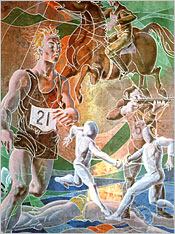
Post-World War II proved to be a prolific period artistically for Erni. Earning himself the name “Renaissance Man,” Erni produced paintings, frescos, mosaics, tapestries, graphics, theatrical costumes for operas, exhibitions and commissions for the likes of the World Health Organization and the United Nations Educational Scientific and Cultural Organization.
Erni designed more than 90 stamps for Switzerland and the United Nations during his career. His monolithic murals, posters and collection of stamps rallied a worldwide following. Proud of its native artist, the city of Lucerne became host to the Hans Erni Foundation in 1977 and two years later was home to the Hans Erni Museum revealing some of the artist’s best works and personality to the public.

One art critic said of Erni’s body of work, “What gives his career particular grandeur is his constant effort to reconcile the world of machines and the dreams of the poet.” The pairing of the realism of machines and the abstraction of dreams describes Erni’s art as well as his personal motto, that “he who combines practicality with pleasure wins all the votes.” Erni lived and worked within the realm of this maxim, and his art concurrently became not only a practical exploration of the human experience, but a whimsical celebration of it.
Sir Herbert Read, Norton Professor of Fine Art at Harvard University said, “Certainly the most talented of those who have refused to despair, who have on the contrary dared to affirm life, who have even greatly dared to cast their joy in the face of destiny, is Hans Erni.” This commitment to the celebration of life made Erni an ideal candidate to produce several works for the International Olympic Committee including a mural, “Olympia – Myth and Reality” for the session hall of the International Olympic Committee in Lausanne, a gold medal in 1992, and exhibitions at several Olympic events.


Style & Inspiration
Hans Erni – Architect of Athletic Achievement – 1988 Sport Artist of the Year
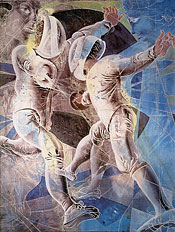
As Erni was affiliated with the Abstract Alliance, he was among the pioneers of the Abstract Expressionist Movement. Erni’s works reflect the style associated with the movement, reshaping the familiar with the intention of expression. His art is less concerned with the visual likeness to real world objects than with the expressive interpretation of them.
But, in this form it is a paradox. As a member of the Abstract Alliance and pioneer of the Abstract Expressionist Movement, Erni declared, “There is no abstract! There is only reality! What we call abstract is only reality as we see it at the time we paint. The next time we paint, we may see it differently.”2 The paradox reaffirms the philosophical teachings of Wölfflin, that even a work with little or no visual likeness to its subject is derived from the knowledge of the subject.
Thus, reality was the inspiration for even Erni’s most abstract works. “What is happening today is full of content and cannot be conceived by a play of colors without form, or by forms without meaning,” Erni said. “Let us have the courage for continuity of meaning in painting, for balanced humanity and tradition.” This allowed Erni to create the “realistic yet mythical” art for which he is renowned.
Erni believed that “Painting is not passive. It strives to convince and it testifies.” And so, his works took on a cause. That cause, whether it be in depicting mythological athletes or heroes on postage stamps, was the celebration of human life. It is, as Erni said, the “responsibility of art to describe the world and science through the realistic skills of illustration.”
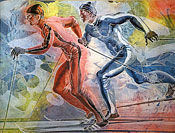
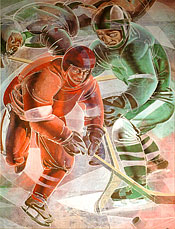
For a man who witnessed the ravages of war, who tirelessly traveled the world in search of knowledge, and who maintained incredible productivity throughout his art career, Erni retained an impressive work ethic and energy. Even at the age of 90, Erni could be found in his studio working on several projects at once. With an appearance described “rugged athlete,” Erni attributed his “indomitable vitality” to his interest in sports. In his youth, he played hockey and liked to ski. His experience in sports and constant attention to the human experience gave Erni a considerable edge in eligibility for Sport Artist of the Year.
Key Sport Works & World Influence
Hans Erni – Architect of Athletic Achievement – 1988 Sport Artist of the Year

Ebie Taylor, executive director of ASAMA at the time, said of Erni, “His sport paintings are a reflection of the beauty of movement and his eye for the mythological aspect of sport gives his work an amazing vitality.”
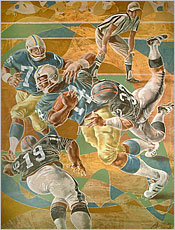
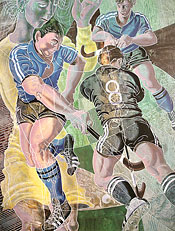
When viewing one of Erni’s sport art works, one can almost visualize the technical process that goes into every competition he captures. Erni’s painting of basketball players conjures images of men soaring to grab a loose ball, each man in the image with their muscle definition impressively on display thanks to Erni’s use of distinctive, white lines in all the appropriate places.
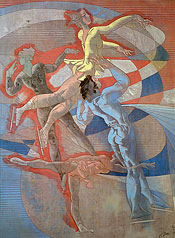
The color use in the background gives the image a dreamy feeling. The people who are viewing it are being taken inside the human body, to experience its twists and turns while competing on the basketball court. The image of a bobsled team preparing to go down the hill effectively captures that moment just before launch, when a mass of humanity flawlessly climbs into a small space inside a sleek machine that reaches speeds up to 90 mph while heading straight down a thin, icy path.
Erni brought science to art, helped us see the technical aspects behind the amazing athletes we love to watch on our televisions and spend our hard-earned dollars to see toil.
Hans Erni celebrated his 100th birthday on 21 February 2009. To celebrate a century’s worth of amazing art, the Museum of Art Lucerne presented “Hans Erni: Retrospective for his 100th birthday.” It presented 230 works, including a Swiss-themed exhibition that stands 91 meters long and five meters tall.
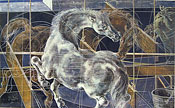
Even to this day, Erni keeps producing amazing pieces of work. To help kick off another century of wonderment, the United Nations in Geneva inaugurated an Erni mural that covers a plain concrete wall that was erected for security purposes after the attacks on America on 11 September 2001. Appropriately enough, the 60-meter long ceramic fresco depicts the hope for peace.
“I want all those people going in there to work every day to see it and think about peace,” Erni told journalists after the mural was inaugurated. “I want them to be inspired.”
There is little doubt that a century from now, Erni’s wish will remain a reality.