Artist archive
James Ridlon
Biography
“Riddles of Excellence” – 1989 sport Arts of the Year
Ridlon discovered painting while in the sixth grade. It was then, too, that he began to collect things. “I was poor and scrounged around for objects I could use. It was fashionable to use found objects,” he said.2 It was a modest beginning. Yet, Ridlon visited flea markets, garage sales and antique shops to satisfy his fascination with things.
As he got older, Ridlon learned to control his stuttering problem and developed into a talented artist and athlete. “I had an excellent art teacher, and I had become a good athlete,” he said. “I came from a very poor family—my father’s people were all lobster fishermen in Maine—and if it hadn’t been for football, I might well have become a coal miner or something like that.”
Instead of mining coal, Ridlon mined his athletic ability and received an athletic scholarship to Syracuse University, giving him an opportunity he might otherwise not have had. From 1954 to 1957 Ridlon played halfback and defensive end for Syracuse University’s football team. “I felt there was a perfect democracy on the field. If you’re faster, you’re better,” he said.
While at Syracuse, Ridlon won the Pat Miller Award for Outstanding Athlete-Citizen-Student and the Joe Alexander Award for Excellence in Football, Scholarship and Citizenship. “I’m very proud I was a good athlete,” Ridlon said. “I played in the same backfield with Jim Brown, and that was an honor.”
Playing football at Syracuse laid the foundation for Ridlon’s future professional football career, “But it was at Syracuse I realized that I also had a mind,” he said. At Syracuse, Ridlon studied under Ivan Meštrović, a prominent Croatian sculptor known worldwide whose works had close ties to Slavic history. Ridlon graduated from Syracuse with a Bachelor of Fine Arts degree in sculpture. At the time, Ridlon said he “didn’t know there even was pro football after college.”
Ridlon played six years with the San Francisco 49ers and two years with the Dallas Cowboys. As a Cowboy, he was named All-Pro as a defensive safety in 1964. An article in the 9 January 1989 Sports Illustrated magazine states, “Jim Ridlon was one of the first tough-as-nails NFL defensive backs in the 1950s and 60s, a rugged tackler and, though not especially fast, a dogged pass defender.” Then, suddenly, at what some called the peak of his career, Ridlon quit pro football and went back to Syracuse to complete his graduate studies.
While continuing his work in fine art, he coached the university’s defensive backs. Later, Ridlon became a full-time professor at the College of Visual and Performing Arts at Syracuse and taught painting, figure drawing, sculpture and design, until he retired in 2000. All the while, Ridlon worked as the color commentator for Syracuse home football games on the New York State Radio Network.
Style & Inspiration
James Ridlon – “Riddles of Excellence” – 1989 Sport Artist of the Year
Ridlon said, “I have drawn on memories, feelings and concepts rooted in my football background. The work might seem whimsical but there is an underlying truth in the statements…because I was there.” For this reason, his unique and inventive expression of the realities of sport, Ridlon was chosen by the Art Committee as the 1989 Sport Artist of the Year.
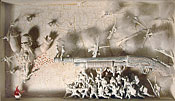
With the whimsical nature of Ridlon’s assemblages, there is a sense of existentialism in that the meaning of something is only in the meaning we give it. “Everything I do, I want to look accidental, but controlled,” he said. To achieve this, Ridlon juxtaposes images or objects that are seemingly unrelated to recreate several layers of meaning. Ridlon said, “This juxtaposition represents two different types of awareness—of the random and the ordered, or, you could say, the accidental and the sophisticated. It also represents the different phases of my own life, the Jekyll and Hyde of me.”
Perhaps one of the influences on Ridlon’s artistic philosophy is what he listens to while working. “I listen to books on my way to and from school and while I’m working on a painting or a sculpture. I love Kafka’s The Castle,” Ridlon said.1 Franz Kafka was a major fiction writer of the early 20th century, and considered to be an existentialist thinker. “You know to me, with all of the problems I had as a kid, there is nothing quite so beautiful as the spoken word, and I can’t believe how beautifully this man writes.”
If a picture is worth a thousand words, then Ridlon’s art could fill more than all of Kafka’s novels. His style of “crowding many things in a small space and making it look organized rather than chaotic,” coupled with inspired titles, creates a kind of refined absurdity. In the absurdity, viewers find deeper meaning and the spirit, life, and drama of sport.
Key Sport Works & World Influence
James Ridlon – “Riddles of Excellence” – 1989 Sport Artist of the Year
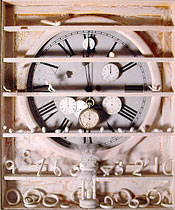
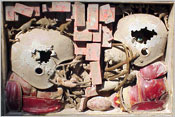
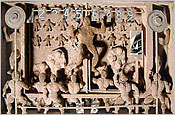
Football played an important part in Ridlon’s artistic works, acting as a theme for many of them. A painter and a sculptor, Ridlon is probably best known for his three-dimensional pieces called assemblages. For his assemblages, Ridlon pieces together just about everything imaginable to convey his artistic message: toy soldiers, pieces of yarn and wood, parts of football uniforms, bicycle parts, to name a few.
Ridlon’s work is displayed in over 500 public and private collections including the Munson-Williams-Proctor Art Institute in New York, The Juilliard School of Music in New York and the Art Gallery of Hamilton in Ontario, Canada. His art has been featured in over 100 group art shows and 37 solo shows such as the Canton Institute in Ohio, the Zenith Gallery in Washington, D.C. and the Herbert F. Johnson Museum at Cornell University in New York.
Ridlon amassed over 20 prizes and awards as an artist and as a teacher. He was named Football’s Man of the Year in Arts in 1976, Letter Winner of Distinction at Syracuse in 1983, College Educator of the Year in 1987 by television networks CBS and ESPN, and was inducted into the Syracuse Hall of Fame in 1990. In 1997 Ridlon received the Outstanding Faculty Award from Syracuse’s School of Art and Design and an honorary doctorate from Cazenovia College.
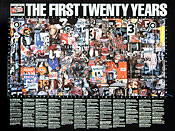
Ridlon’s assemblages, for their uniqueness and easily assimilated specificity to particular projects, propelled his fame. He was commissioned to create a piece for ABC Television to commemorate the 25th anniversary of its Wide World of Sportsprogram. The assemblage, a 12 ½ by 8 feet collection of memorabilia, consisted of, among other things, ice skates from Olympic figure skater Peggy Fleming, a robe from boxer and three-time World Heavyweight Champion Muhammad Ali, and a soccer ball from Brazilian superstar Pele. He was also commissioned to create assemblages for the 20th anniversary of ABC’s Monday Night Football program and the 100th anniversary of Syracuse football program.
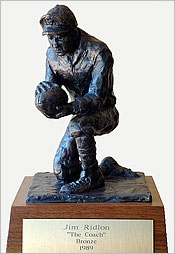
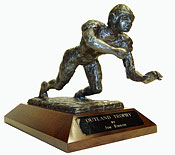
Perhaps the most recognized Ridlon commission is a sculpture made for the Football Writers Association of America called the Outland Trophy. The trophy, an award given annually to the best collegiate interior lineman, was an inspired and challenging piece for Ridlon. He said, “I wanted to get the look of a player of the 1940s, when the award was originally given. I also wanted to make the face ambiguous—it could be white or black—so the person who wins the trophy can see himself in it.” Commenting on the trophy, Morin Bishop of Sports Illustrated wrote, “No-necks or not, the nation’s grunts can finally hold their heads high.”
While sports are important to Ridlon’s art, scenic, outdoor landscapes continue to have an equally vital impact, especially with his acrylic paintings. “Changing Seasons,” a series of under glazed acrylic paintings, depicts the seasonal shifts of Central New York through 80 small, paintings. Though his assemblages are widely recognized, and perhaps the most viewed and curious pieces of art in the American Sport Art Museum and Archives, Ridlon prefers painting to all other media as a means of expression.