Artist archive
LeRoy Neiman
Biography
“Father of Contemporary Sport Art” – 2007 sport Artist of the Year
“I created LeRoy Neiman. Nobody else told me how to do it. Well, I’m a believer in the theory that the artist is as important as his work.” ~ LeRoy Neiman; www.leroyneiman.com
For this trendsetting American painter, art doesn’t merely imitate life. Neiman’s art and his life are inseparable aspects of one dynamic experience. Artistic innovator, productive painter, fine draftsman, media showman, philanthropist, and bon vivant, LeRoy Neiman brings his unique combination of talent, personality, and high energy to every painting and public event in which he participates, fusing the concepts of art and artist in productive and exciting ways.

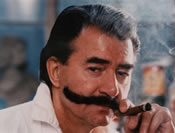
Neiman’s groundbreaking work has garnered countless international accolades and awards. However, to the general public, he is most widely known as the remarkable, entertaining artist who invented the genre of Contemporary Sport Art. The key turning points in this process were his appearances on live television painting athletes at the very moments that they were competing in the Olympics. Neiman produced artwork on screen, working from a blank canvas to a finished action painting, sporting his signature long handlebar mustache, often dressed in a jaunty hat, and smoking a cigar. No one had attempted to make fine art an onsite, real-time part of major media sports before. These displays brought art back to the forefront of sports events where the Olympics’ founder, Pierre de Coubertin, had insisted it belonged.

The demonstrations also created an indelible memory of Neiman for anyone who saw the colorful artist making his dynamic portraits of athletes. Worldwide, July 1972, millions of television viewers watched Neiman sketch Bobby Fischer competing against Boris Spassky at the world champion chess tournament in Iceland. In August and September 1972, ABC-TV broadcast Neiman drawing scenes live at the Summer Olympic Games in Munich, Germany. He worked in a variety of fast media, including watercolor, chalk, pencil, charcoal, and felt-tip pens. Next, Neiman demonstrated his action painting for television during the Olympic Games in Montreal in 1976, at Lake Placid 1980, and in Sarajevo and Los Angeles 1984. Going high tech during the 1978 and1979 Super Bowls’ CNS-TV broadcasts, Neiman employed a computerized electronic pen to draw the sports events. He was honored as the official artist for the 1979 and 1980 Sports Spectaculars on CBS-TV. At the 1980 Democratic National Convention, Neiman was the official artist to record the historic event. In 1986, Neiman was chosen as the official artist for the Moscow Goodwill Games on Turner Broadcasting Network.

Neiman’s artistic skills, business savvy, and engaging personality bring him exceptional access to the players and usually tickets to the best seats in the house. No reclusive, impractical artist, Neiman learned from his association with sophisticated art colleagues during the 1950s, ‘60s, and ‘70s how to create a memorable media personality and how to effectively combine fine art and first rate business.
“Business art is the step that comes after Art… I wanted to be an Art Businessman or a Business Artist.” ~ Andy Warhol; Artist to Artist, Jackson Creek Press, p. 38
Many of Neiman’s business skills as well as his taste for the high life came from his association with the icon of 1950s fast living, Hugh Hefner. Hefner and Neiman met when both were just beginning to climb their professional ladders and recognized their kindred spirits and mutually beneficial talents. Hefner hired Neiman, working freelance at a Chicago department store at the time, to draw illustrations for his fledgling Playboy magazine. Neiman’s first story illustrations earned Playboy Magazine a Chicago Art Directors award and propelled Neiman into a glitzy career as one of Playboy’s main artists. Neiman also wrote his own ongoing Playboy feature called “Man at His Leisure” for which Neiman produced many illustrations of sporting events and social galas at some of the world’s most famous vacation hotspots.
As a youth, raised in a hard scrabble, blue-collar St. Paul, Minnesota neighborhood, Neiman had used his artistic talents to earn extra money painting signs for shopkeepers and posters for school events. Later during his stint in the U.S. Army, Neiman painted murals on dining hall walls and stage sets for Red Cross shows. Military life with its strictly regulated power strata brought home to Neiman how much more fun life at the top of the heap could be than at the lower registers. However, Neiman never lost his interest in all types of people from all walks, and their varied lifestyles would become the subjects of many of his paintings. More important to Neiman than the material advantages of the upper classes was the capacity for adventure and for living life at one’s fullest that Neiman observed and learned to emulate.
“Playboy made the good life a reality for me and made it the subject matter of my paintings– not affluence and luxury, as such, but joie de vivre itself.” ~ LeRoy Neiman; VIP Magazine, July 1962
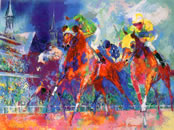
In 1961, perfecting his joie de vivre, Neiman rented a studio in Paris and produced studies of the Deauville racing and social season as well as famous French restaurants. He won a gold medal at the Paris Salon d’Art Moderne. He also spent exciting time in Italy painting gondoliers in Venice and the filmmaker, Federico Fellini, at work. He developed a taste for the glamour and grit of gambling casinos, horse racing, nightclubs as well as the celebrities, sports stars, and ordinary working people who frequented them. This heady mix of people would become fans and patrons of Neiman’s inside portraits of their worlds. While enjoying all his adventures, Neiman also worked hard at his art and developed a unique style of painting that would carve him a special niche in the history of art. Throughout it all, he cultivated his flamboyant public persona that had become both a source of creative energy and an inseparable part of his art.
“I like being outrageous. I don’t actually do anything except be conspicuous. It keeps me revved up… My performance is part of my success.” ~ LeRoy Neiman; www.leroyneiman.com
Style & Inspiration
LeRoy Neiman – “FATHER OF CONTEMPORARY SPORT ART” – 2007 SPORT ARTIST OF THE YEAR
“He found an extremely dynamic way of making the abstract background and realistic foreground merge and separate simultaneously by alternately fusing and separating the two spaces. In this remarkable synthesis, he was able to make the action within the painting as intense as it actually is in our direct experience.” ~ F. Lanier Graham; www.leroyneiman.com

In the long history of Sport Art, from ancient Greek statues of ideal athletes to the serene paintings of English thoroughbreds by George Stubbs, the stylistic timeline is distinctly divided between Before Neiman and After Neiman. Sports in European artworks most often were portrayed with athletes frozen mid-motion and in Classical images of aristocratic pursuits such as fox hunting, rowing, elegant horse racing, badminton, and fencing. Portrayals of sports scenes were relatively rare in 19th century art and reflected the images of the ancient Greek ideal of perfect Olympic athletes.
The 20th century saw a change in public aesthetics. The brash American Revolution in the 1700s had resulted in shifting the social and artistic spotlights in the 1800s from aristocrats onto average citizens and the nitty-gritty sports they enjoyed. By the early 1900s, the American upstarts had overturned their European ancestral influences with more democratic depictions of athletes and sports as well as the leisure pursuits of the newly affluent middle class. By the 1950s, overturning tradition and seeking change in every aspect of life, including art, music, and social mores, became a good rather than a threatening theme, and faster was always better.
“Roll over Beethoven and give Tchaikovsky the news! … Roll over Beethoven! Dig these rhythm and blues!” ~ Chuck Berry, on the stylistic revolution in modern music, 1956
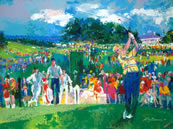
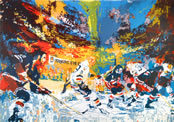
This obsession with transformation and speed surfaced in the art styles of major, influential artists. Here was art that communicated the pains and pleasures of chaotic contemporary life, including its high-energy sports. The general public reacted to art’s frenetic mood with pleased recognition. However, until Neiman’s stylistic innovations of the 1960s, no art style thoroughly portrayed the speed, intensity, and iconoclastic spirit of contemporary sports. Neiman’s style not only made sports art more popular, his focus on dynamism made it more genuinely contemporary.
“Here lies the prime objective of my work – this phenomenon of change. The spectator looking at a painting of mine must deal with this condition of change. Areas are broken up at close range and fit together only at a distance… These plastic qualities of my painting coincide with the realities of contemporary society and its rapidly moving, shifting and ever-changing panorama.” ~ LeRoy Neiman; www.leroyneiman.com
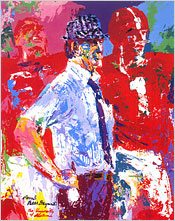
The most obvious dynamic layer of Neiman’s technique captures the viewer’s attention with the familiarity of its contemporary energetic mood. The next more subtle layers lead the viewer beyond the surface into the deeper elements swept along in this whirlwind of motion.
“Ready recognition of key elements (in my art) is difficult because of a certain lack of clearness… I seek to make the task of the spectator increasingly difficult… By venturing into and penetrating the painting, the spectator discovers for himself new substances and has a prolonged contact… This gives the spectator more room for conjecture, and his contribution to the visual image, upon contemplation, adds to its provocative possibilities.” ~ LeRoy Neiman; www.leroyneiman.com
Although Neiman’s techniques employ paints that cover large spaces fast and dry quickly as well as brush strokes swiftly applied in swooping strokes, these portrayals of speed ultimately lead the viewer into contemplation of what’s missed with quick surface glances, the value of exploring deeper, slower realms.
“Today’s man accepts many casual observations and oft-times the real truths escape him if he doesn’t take the time to look beneath the surface.” ~ LeRoy Neiman; www.leroyneiman.com
Much of the history of art revolves around one long debate about the nature of reality and questions of our ability to perceive it clearly. What is real and what is illusion? What methods can we employ to examine these questions more thoroughly? Each change in art style in different eras is an attempt to approach these basic life questions from a new angle. Are life’s important issues better examined by the precision of Classical draftsmanship and Photo-Realism or by the emotional explorations of unconscious realms of Surrealism and Expressionism?
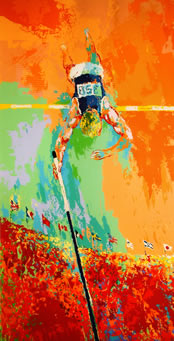
The revolutionary splatter art of Jackson Pollack in New York in the 1950s and 1960s was an attempt to strip away all nonessential elements of painting and get to the root of its vital energy. Taking the movement of the artist’s body as he or she spread paint on a surface as the starting point of artistic creation, Jackson made paintings in which the tracks of the artist’s body energy recorded by pure splashes of paint in no representational forms provided the sole content. Contemporary Action painters and Abstract Expressionists such as Franz Klien and Robert Motherwell were greatly influenced by centuries old theories of recording the artist’s energy in Chinese and Japanese calligraphy. Neiman found the techniques of the Action Painters very useful to his purposes and then took them into whole new realms by adding his own technical inventions. These stylistic breakthroughs have made Neiman’s paintings famous and significant to any collector interested in the history of contemporary art. Neiman’s style also happens to be perfectly suited to recording the motion and energy of high performance sports.
Neiman usually paints on Masonite or Upson board coated with a polymer ground and covered with large areas of commercial enamels. Next come glazes of oil paints, all in vivid colors. Then suggestions of the representational images are applied.
“Areas are broken up at close range and fit together only at a distance. As one advances on my painting, it becomes more abstract, more fluid, and as one moves away, it falls into focus and is realistic… At no two distances will the painting appear the same.” ~ LeRoy Neiman; www.leroyneiman.com
Neiman creates most of his commissioned paintings in his New York studio across the street from Central Park where he also shares an apartment with his wife, Janet Byrne, whom he married in 1957. Neiman is assembling a collection of his works for preservation at the Smithsonian Institution in Washington, D.C. He has been a member of the New York City Advisory Commission for Cultural Affairs since 1995. Neiman received an Award of Merit form the American Athletic Union in 1976, a Lifetime Achievement Award from the Muscular Dystrophy Association in 1986, and in 1995 he donated $6 million to create the LeRoy Neiman Center for Print Studies at Columbia University’s School of the Arts.
Neiman took the revolutionary techniques of Found Art and pushed them even further into new realms by performing the act of artistic creation live on the era’s most popular technology. Not simply an icon of contemporary culture was used as the center of his art but the whole event of artistic creation which became the ‘found object.’ This extraordinary man of action has made art more of a living part of all our lives, and his artworks will continue to energize and inspire many generations.
Key Sport Works & World Influence
LEROY NEIMAN – “FATHER OF CONTEMPORARY SPORT ART” – 2007 SPORT ARTIST OF THE YEAR
- 1950-1960
- Faculty member, School of the Art Institute of Chicago
- 1957
- First TV appearance, Art Institute of Chicago’s “Artist’s Choice”
- 1957
- Creates “Femlin” character which appears in Playboy magazine for 55 years
- 1958
- Creates Playboy magazine feature, “Man at His Leisure” that runs for 15-years
- 1960
- Paints at Squaw Valley Winter Olympic Games
- 1964
- Neiman’s first painting of Muhammad Ali
- 1968
- Cover of Time magazine, portrait of hockey star, Bobby Hull
- 1972
- July – Sketches Bobby Fischer competing against Boris Spassky, live ABC-TV, World Champion Chess tournament in Iceland, as well as sketching at Munich Olympic Games
- 1972
- August & September –Draws sports scenes on live ABC-TV broadcast at Summer Olympic Games in Munich, Germany
- 1972
- Draws every round of Ali-Frazier boxing match
- 1973
- Creates super Bowl art for NBC-TV
- 1974
- Covers Stanley cup hockey play-offs for NBC-TV
- 1975
- Exhibition at Minnesota Museum of Art
- 1976
- Paints mural on TV broadcast as Official Artist, Olympic Games, Montreal
- 1976
- Award of Merit form American Athletic Union
- 1978 & 1979
- Creates first live computer art for CNS-TV Super Bowl broadcast
- 1979 & 1980
- Official Artist for Sports Spectaculars, CBS-TV
- 1980
- Official Artist, live TV broadcast of Lake Placid Olympic Games
- 1980
- Official Artist, Democratic National Convention, New York
- 1984
- Action painting on TV as Official Artist, Olympic Games, Sarajevo & Los Angeles
- 1986
- Official Artist for Moscow Goodwill Games on Turner Broadcasting Network
- 1986
- Official Artist, Goodwill Games, TBN-TV in Moscow
- 1989
- Sketches World Series, Candlestick Park, San Francisco, during earthquake
- 1990
- Paints the Masters golf tournament, Augusta, Georgia
- 1994
- Paints Pebble Beach Golf Clubhouse, Super Bowl XXVII in Atlanta, Luciano Pavarotti at Metropolitan Opera, and Frank Sinatra for “Duets II” Album
- 1995
- Elected member of New York City Advisory Commission for Cultural Affairs
- 1995
- 40-foot high theater murals for Broadway choreographer, Tommy Tune, New York
- 1996
- United Nations commission for six postage stamps of Centennial Olympic Games, Atlanta
- 1997
- Inaugurates the LeRoy Neiman Center for Print Studies, Columbia University, New York
- 1998
- American Sportscasters Association (ASA) Humanitarian Award
- Inaugurates LeRoy Neiman Center for the Study of American Culture & Society, UCLA
- 2000
- 1ST LeRoy Neiman Art Center for Youth opens in San Francisco
- 2001
- Paints official 2002 Mardi Gras poster
- Salutes Muhammad Ali as “Athlete of the Century” in painting & serigraph edition
- 2002
- Painting of Wayne Gretzky, gold medal winning Canadian Olympic Hockey Team
- 2003
- Commission to paint New York Yankees outfielder, Hideki Matsui to benefit 2005 Special Olympics, Japan
- 2004
- Commission to paint New England Patriots football team owner
- 2005
- Commission to paint 100th anniversary commemoration of City of Las Vegas
- LeRoy Neiman papers received by Archives of American Art of the Smithsonian
- 2006
- Opening of LeRoy Neiman Art Center for Youth, Pier 9, San Francisco
- 2007
- Commission to paint official image for Ryder Cup 2008
- Commission to create Muhammad Ali-inspired collection for Adidas
- 2008
- Commission to create mural at Sports Museum of America, New York
- 2009
- Creates USA Olympic painting for Vancouver Winter Olympics
- 2010
- Official Artist of 2010 World Equestrian Games; commission to create painting to commemorate this event