Artist archive
Murray Tinkelman
Biography
“Gold Standard Graphics” – 1995 Sport ARTIST oF tHE yEAR
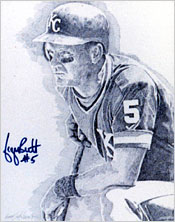
Illustrations by Murray Tinkelman have won gold medals from Society of Illustrators, Society of Publications Designers, and The New York Art Directors Club. His works stand in the permanent collections of many museums, including International Photography Hall of Fame & Museum, New Britain Museum of American Art, Delaware Art Museum, Brooklyn Museum, and American Sport Art Museum and Archives. Top drawer publications such as The New York Times, Atlantic Monthly, and The Washington Post all have published his illustrations. The National Park Service commissioned Tinkelman to produce drawings and paintings of National Parks and Monuments. The U.S. Air Force chose him as an artist-reporter on several missions. The National Baseball Hall of Fame in Cooperstown honored him with a one-man exhibit of Tinkelman’s baseball art.

All these heavy duty accolades are heaped on a down-to-earth artist who attributes his major inspirations to the pop culture icons of his 1940s and ‘50s Brooklyn boyhood. Murray spent much of his childhood playing with neighborhood kids, going to movies, watching baseball, and ogling at the curvy, chromed 1950s car designs. His art-oriented high school, School of Industrial Art, offered thorough training in the basics of drawing, photography and filmmaking. Later he attended the prestigious Cooper Union Art School, but quit before graduating because he thought their attitude toward illustrators condescending. Sports supplied him with dynamic heroes, but cowboys and science fiction creatures were also key influences on his later art.
“The Saturday afternoon matinees of the 1940s were the inspiration for my love affair with cowboys and Indians… Although there were no cows in Brooklyn and precious few horses… my Dad was an avid reader of pulp westerns. I read and reread his discarded… paperback books. I will never forget the thrill I experienced when I first read The Virginians immortal line, ‘When you call me that, smile!’” (tinkelmanstudio.com).
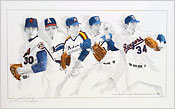
Throughout his career, Tinkelman continued to pursue his art with youthful enthusiasm, humor, and hard work. These qualities would serve him well during his struggles to establish himself in the competitive advertising business of 1950s New York. As a fledgling commercial artist, he tenaciously held his ground against the romanticism and glossy, idealized pictures of status quo 1950s and ‘60’s advertising. On assignments, he drew it his way. He retained the intricate black and white pen strokes, and the unique, gritty, graphic edge for which his work would become famous.
Tinkelman’s first big break came when he met one of his key mentors, Chuck Cooper, who had established the influential Charles E. Cooper Studios at the corner of 57th and Lexington, New York. Known as the preeminent illustration studio from the late 1930s through the early 1970s, the firm’s upscale glamour intimidated Tinkelman on his interview there. Tinkelman was desperate to escape the humdrum limits of his greeting card job and rise to challenging, contemporary work. He describes his introduction to this cosmopolitan business world that he would ultimately help change:
“There’s Chuck. Short, maybe 5’6”, wearing a white shirt, open at the collar, and the tie was pulled down a bit. His sleeves were rolled up, and his office was a symphony of black glass, teak, and mahogany, with books lining the shelves. Beautiful original art work on the walls… He looked at my stuff. Never said a word… Turned his back to me, put his hands in his pockets, and said, ‘What do you want?’ … I blurted out, ‘I want to make a living making art work. I want to be able to look at myself in the mirror in the morning.” Without much fanfare, he said, ‘All right. Come in Monday.’”
Illustration Magazine, 2006; pp. 52-53
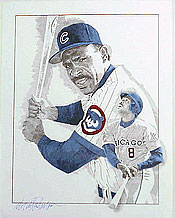
On starting his new job, Tinkelman found that he was the youngest and most controversial artist among a large pack of famous, established professionals. He took the old guard’s ribbing with characteristic good humor. It never dampened his rebellious assault against expected, smoother drawing styles.
“Someone once described me as ‘the savage on the 11th floor.’ Every once in a while someone would throw in a piece of raw meat and slam the door shut… It was my role as a representative of the next generation… I was the experiment with a kind of loose, expressionistic painting. My stuff was truly off the-wall… (with )a little bit of bite to it.” ~ Illustration Magazine, 2006; p.56
Tinkelman found inspiration for both his artwork and his soon-to-be-famous presentation style from a teacher at Cooper Union. Tinkelman had a Max Bechmann scholarship that allowed him to spend time at the Brooklyn Museum. There he met Reuben Tam who critiqued his art work and became his mentor in painting as well as his new interest in lecturing about art history. Several other artists from the Cooper Studio were so impressed with the rave reviews of Tam’s erudite, poetic style of teaching that they also joined the class.
At work at Cooper Studios, Tinkelman found another important ally. Staff artists depended on jobs brought to them by in-house sales representatives who hawked the illustrators’ work to outside companies. Tinkelman’s favorite rep at the Cooper Studio was Bill Erlacher, who secured the most jobs for him. The rest of the reps were very old school in their tastes and did not send him much work. When Erlacher left the Cooper Studio to join a new group, Artist Associates, Tinkelman changed firms with him. His move was part of a larger, industry-wide downsizing of advertising businesses from huge, complete service companies to leaner, niche firms made up of young designers. The move was good for business and hard on his deep friendship with Cooper.
“I was literally invented by Chuck (Cooper) on one hand, and Reuben Tam on the other. Totally different characters. I loved Chuck, and at no time, ever, did I forget how important he was to me.” ~ Illustration Magazine, 2006; p.56
Tinkelman was selected as Professor Emeritus from Syracuse University where he had taught Illustration in the undergraduate program and the Independent Study M.A. Program. He also became Director of University of Hartford’s Limited Residency M.F.A. program. Tinkelman’s wit, as in demand as his art, has gained him a gold card reputation as a guest lecturer and as a popular professor of art history. Commenting on a Tinkelman presentation at Dennos Museum Center of Northwestern Michigan College, the Curator of Education & Interpretation, Kathleen Buday said, “Murray’s dynamic presentations were entertaining and insightful, filled with anecdotes that enchanted all in attendance” (tinkelmanstudios.com).
Style & Inspiration
Murray Tinkelman – “GOLD STANDARD GRAPHICS” – 1995 Sport Artist of the Year

As in his fascination for the world of cowboys and Indians, Tinkelman gravitated toward eccentric, colorful arenas and the characters that inhabited them past and present. When he couldn’t find enough quirky characters in real life, he invented them. As an illustrator, he developed a specialty in science fiction and genre books, making imaginary critters and their worlds visible through his art. In advertising, Tinkelman’s black and white detailed drawings of odd machines and personalities stood out starkly among the other artists’ romantic, bright palette magazine illustrations.
During an interview by ASAMA Art Curator, Robert Zimlich, Tinkelman cited the work of Italian painter, Giorgio Morandi as a major stylistic influence. Many of Morandi’s paintings from the early 1900s were done in the Metaphysic movement style. Later in the mid-1900s his work became focused on the Futurist movement. An eloquent draughtsman, Morandi produced many refined etchings as well as paintings. He used a nearly monochromatic palette with muted tones and spare content, all of which produced representations of real objects that seemed nearly abstract. His work is striking in its apparent simplicity that belies sophisticated concept and technique. His spare still life works are considered key forerunners of Minimalism. The iconoclastic filmmaker, Federico Fellini was a great admirer of Morandi’s groundbreaking work. Morandi’s concentration on hazy atmospheres, black and white palettes, and real objects in unusual relationships strongly influenced Tinkelman’s artistic vision. As Morandi did, Tinkelman developed a unique artistic language and did not hesitate to follow his own views even when they went against the crowd’s.

In sports as well as in science fiction movies, Tinkelman turned the spotlight on the underdogs, and the nobility of their struggles. From rough and tumble athletes, cowboys, rodeo clowns and motorcycle riders to movie monsters on the run, Tinkelman views them all as sympathetic misfits trying to make it in a world fraught with desire and danger.
“I’ve always had a soft spot for King Kong. We share the same birthday, we were both born in 1933, and neither of us like ocean voyages… The poor guy was gassed, gorilla-napped and brought back to New York in chains… Poor Kong met his fate like all too many New Yorkers. He was chased, and machine gunned and fell to his death in midtown Manhattan in front of a gawking and unsympathetic mob” (tinkelmanstudio.com).
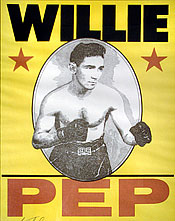
Often Tinkelman constructed creatures in his drawings that were combinations of beast and machine. These imaginary crossbreeds elicit the conflicting feelings of fondness and fear that most of us have for the machines that have grown to dominate our living. Fascination with newly emerging machines was characteristic of much art of the 1960s and ‘70s. Tinkelman captured the trend early and best, with a rare thoroughness, subtlety, and humor. Tinkelman’s warm attitude toward the robots he created was formed in the 1940s and ‘50s. These were times before the American affair with machinery had passed into later stages when some of the more sinister effects of these inventions had shown their true teeth and exacted their full price.
“I love machinery. I love drawings, photographs and diagrams of machinery, particularly diagrams. They look important, they demand respect, and they inspire confidence… The blueprint also is… looked upon with awe by the mechanically illiterate, such as myself. These drawings are my semi-respectful homage to all the model airplanes that I almost completed… and to those… engravings that graced the pages of the… encyclopedias of my youth” (tinkelmanstudio.com).
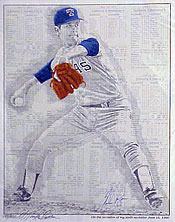
Tinkelman drew each of his beloved hybrid creatures with the precision and realism of an exacting master draughtsman and alien medical illustrator. Former Art Director, U & LC, Herb Lubalin says of Tinkelman’s outstanding graphics: “Tinkelman’s mechanical animals are the combined accomplishment of a creative mind and a dexterous hand, two characteristics so often missed in today’s so called ‘art’ in America. Murray Tinkelman’s contributions to the graphic arts lend considerable luster to an already illustrious profession”(tinkelmanstudio.com). His fondness for the phantasmagoria of the machine age marked the fading of the people-centered Norman Rockwell image of America and heralded the more technology-centered society and art to come.
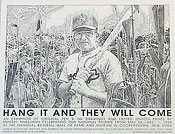
Key Sport Works & World Influence
Murray Tinkelman – “Gold Standard Graphics” – 1995 Sport Artist of the Year
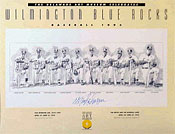
From his one-man shows and museum selections to his academic appointments and many awards, Tinkelman’s groundbreaking career has conquered the top echelons of the art world for several decades. He became as well known for illustrations in distinguished mainstream publications as he was for his cult audience science fiction work.
“Tinkelman almost singlehandedly revolutionized the horror genre… when his work began appearing on the covers of del Rey’s mass market editions of books by noted horror author H.P. Lovecraft.” ~ Vincent Di Fate, Author & Illustrator
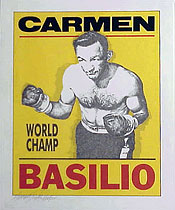
As science fiction writer Lester del Rey said of Tinkelman’s expressionistic style, “He caught the feeling of fantasy behind the shudders, and gave it form and grace” (tinkelmanstudio.com). In all his triumphs, his generous acknowledgement of the contributions of previous “anonymous journeyman illustrators,” key mentors, and fellow artists contributed as much to his renown as his art skills.
As a successful artist, Tinkelman translated some of his public clout into a benefit for some courageous sports underdogs. He invited 168 prominent artists from around the U.S.A. to paint their interpretation of a baseball card. Most of the resulting cards are autographed by the famous baseball players presented. Fifty percent of the proceeds of the exhibition’s rental fee went to the Special Olympics in each city that contracted the popular and ongoing show.
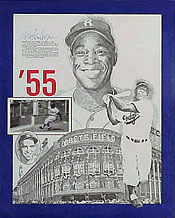
Tinkelman shares his enthusiasm for the colorful history of illustration in his renowned lecture series. According to Sotheby’s Institute of Art Public Programs Manager, Sara Moore, “Aside from being an accomplished artist, Murray Tinkelman is a fantastic lecturer… He initiated a dialogue that I wish all of our lecturers could do.” His humor and astute analysis have propelled his talks to the realm of academic legend. Elizabeth Traynor, Chairman of Illustration at Delaware College of Art & Design enthuses, “Not only did he charm our students, faculty, staff and the public with his witty and entertaining lecture, but he opened their eyes and minds to the history and foibles of the illustration and design fields as well as his own illustrious career.” Tinkelman enjoys passing on his knowledge and motivating the next generation to greater heights.
“He always leaves his audience inspired to take their own work to a higher level.”
Terrence Brown, Director, Former Director, The Society of Illustrators, New York
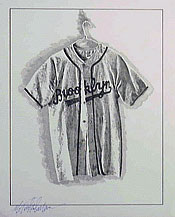
Often modesty does not accompany fame. Here Tinkelman breaks the mold again. Told by a perceptive interviewer that he was credited with spearheading the major shift in commercial illustration styles in the 1960s, Tinkelman commented, “I would love to take credit for something like that, but I don’t think that would be accurate… Things were changing” (Neil Shapiro, Illustration Magazine, 2006; p.55). Tinkelman’s work has enriched our collective vision and heightened our expectations for excellence in illustration. He has been dubbed “Creator of Gold Standard Graphics.” Considering his self-effacing, wry perspective, on hearing that title, it’s a good bet he’d be thinking, “When you call me that, smile!”