Artist archive
Paul Goodnight
Biography
“A Voice of Historic Visions” – 1997 Sport Artist of the Year

Visions from history were this soldier’s hell until they shone light on an unexpected path to his salvation. In 1969, returning from two years service in Vietnam, Paul Goodnight was haunted by nightmares from his war traumas that triggered a stutter so severe that he could barely speak. His attempts to block the memories with drugs proved futile. Then a tragic event offered Goodnight what he called “a reprieve” from the search for oblivion. The suicide of a close friend jolted him out of his private world and into a quest for a way to live a full life even with the pain. After quitting drugs, Goodnight began exploring his childhood practice of using art to communicate.
“Art is making me, rather than me creating it.” ~ Paul Goodnight

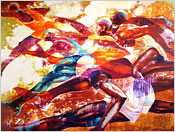
Goodnight’s visions became his guide. He started painting scenes that chronicled the agonies of history as well as the ecstasies. He drew people at moments of achievement, surrounded by images from their history as well as their present struggles to show how every part of their lives contributed to the triumph. Developing his own style, he often painted portraits of great athletes filling the space around the figures with symbols of their cultural heritage. In his own history, he researched elements of his African roots and presented them as part of the stories in his paintings. Goodnight had found his voice.
“When the artist can make art the medium for a greater love, only triumph is possible.” ~ Barry Edmund Gaither, Director, National Center for African-American Art.
Realizing that this passionate hobby could become his profession, Goodnight pursued in-depth training. His studies at the Massachusetts College of Art led to completion of his Master of Fine Arts degree. Several influential African-American artists, including John Biggers and Alan Rohan Crite, became his mentors.
Goodnight had had supportive caregivers around him from an early age. Born in Chicago, he moved to Connecticut with a loving, nurturing foster family. Goodnight’s understanding of art’s potential role in his economic survival started in childhood. As a schoolboy, when he didn’t like what he found in his lunch bag, he sold pencil sketches of nudes at 25 cents each to schoolmates. He used the income to buy a hot lunch. Remembering this cycle as an adult, Goodnight and his partner, Bernice Robinson created Color Circle Art, an organization based in Boston dedicated to developing both artistic and business skills in young artists, as well as publishing and providing fine art information and consulting to collectors across the globe. Aziza, the daughter of Robinson and Goodnight, carries on the family tradition of helping young artists by teaching art in Boston schools.

When several of Goodnight’s paintings were included in the sets for popular television shows, the media exposure widened the audience for his work and brought him many celebrity clients. Former Detroit Pistons point guard Isiah Thomas and actor Wesley Snipes became frequent buyers of Goodnight’s work. His first foray into the television outlet came in 1984 when one of his paintings was included in a set for “The Cosby Show.” After the positive response from that break, use of his art on other shows followed, including “Fresh Prince of Bel Air,” Seinfeld,” “ER,” and the film “Ghost.” Goodnight regularly continued sending paintings to the Hollywood Cinema Arts organization that chooses artwork for productions.
Since 1984, Goodnight’s art has gained acclaim from exhibitions in such prominent arenas as the Boston Museum of Fine Art and Schomberg Institute, New York. His pieces hang in many distinguished galleries and museums, including The Smithsonian in D.C. In 1996, he was commissioned to design the commemorative poster for the Atlanta Summer Olympics. In 1997, the United States Sports Academy chose Goodnight as their Sport Artist of the Year. In 1998, Goodnight designed the World Cup Soccer poster. His painting titled, “The Network” is part of an international traveling exhibition for the 2010 World Cup in South Africa. With their impact on representing multi-cultural themes, Goodnight’s visions from history now make history and offer inspiration to people worldwide.
“I feel I’m contributing positively and getting a sense of confidence and pride by doing something that people consider worthwhile for spiritual, material and/or educational reasons. And it keeps me out of trouble.” ~ Paul Goodnight
Style & Inspiration
Paul Goodnight – “A Voice of Historic Visions” – 1997 Sport Artist of the Year
“I would like to be a skilled and consummate draftsman. I try to use a collection of sensuous colors, often revealing mysterious hidden forms, infusing them into an environment of endless nuances where abstraction and representational images are comfortable in the same space and where passion and humanity resonate.” ~ Paul Goodnight, Artist Statement, Color Circle Art

Goodnight’s description of his style could just as likely have been voiced by the great fathers of 19th century French Symbolism, Gustav Moreau and Odilon Redon, or later by Marc Chagall in the early 20th century. Moreau and Redon established Symbolism’s reverence for the power of myth using iconic images from history and allegories from the collective unconscious. They mixed representational and abstract elements in their works. These they surrounded with intense fields of color and large, visible brush strokes to indicate energy forces that became characters in the paintings as important as the human or animal figures. In Goodnight’s works, the areas of color and design also are as interesting and dominant as figures. The techniques and concepts of this early Symbolist movement proved useful to many 20th and 21st century artists seeking to include voices from history in their works.

Another great French artist, Gustav Courbet, pioneered a concept that would become a cornerstone of art theory in the 20th century. Courbet broke from the preceding preference for selecting lofty, idyllic scenes by stating that his goal was to understand his subjects from firsthand experience.
“To know in order to be able to do… To be in a position to translate the habits, ideas, the appearance of my time… in a word, to make a living art, that is my aim.” Excerpt from Courbet’s manifesto of Realism; Modern Art, David Britt, Thames & Hudson, 1989, p. 305
Goodnight expresses a similar goal in his Artist Statement in Color Circle Art when he writes:
“I also try to offer the rich evidence of love in the composition of ordinary Black people whom I’ve witnessed in my travels around the world. Men, women and children who are familiar, intimate and engaging have stories written all over them, waiting to be told. My goal is to expose these stories to delight the eye and to satisfy the spirit – in short, to make them live.”
Along with such African-American masters as narrative muralist John Biggers and spiritual painter Alan Rohan Crite, Goodnight also credits contemporary artists Dana Chandler, Gary Rickson, and Paul Rahilly with having significant influence on his work. In the 20th century, the Modernist movement freed artists from adhering to any one style and promoted combining all styles needed to communicate.
“If my work can help others reach a greater understanding of some aspect of the African or American experience, that’s a positive thing… To define myself as an African-American artist doesn’t put limitations on me. Rather, it’s uplifting and it pays tribute to the fact that my ancestors came from a rich cultural heritage… The art world is so much larger than that! There’s literally room for anything and everything.” ~ Paul Goodnight
Goodnight continues to invent new combinations of styles to better communicate his themes. He explores different cultures in his trips to Africa, South America, Eastern Europe, the Caribbean, and China. The past and present of all these civilizations influence his art that functions as an ambassador for multi-cultural respect and appreciation of history.
“I see myself continuously working and traveling and making connections between where I was and where I am now.” ~ Paul Goodnight
Key Sport Works & World Influence
Paul Goodnight – “A Voice of Historic Visions” – 1997 Sport Artist of the Year
“I have seen so much young talent that I feel it’s my responsibility to help it blossom by carrying on the teaching legacy of my own mentors.” ~ Paul Goodnight
- 1984
- “Cosby Show” features a Goodnight painting
- Painting exhibition at Boston Museum of Fine Art
- 1991
- Governor of Massachusetts proclamation for MBTA mural, “Geometree”
- Founder, Color Circle Art Publishing, Boston
“Color Circle Art Publishing is dedicated to the perpetuation of a culture by making widely available the compelling and revealing imagery of African Diaspora visual artists.” ~ Paul Goodnight
- 1996
- “Feet Don’t Fail Me Now” – painting commemorating Atlanta Centennial Olympic Games
- 1997
- Sport Artist of the Year, United States Sports Academy, Alabama
- 1999
- African American Achievement Award
- Design for ceramic mural at Orlando Airport
- 2000
- African American Achievement Award
- 2003
- “In the Spirit of Martin” traveling group exhibition
- “Voices on Paper,” Hearne Fine Art, Little Rock, Arkansas
- National Black Fine Art show, Puck Gallery, New York
- 2008
- Beijing Olympic Games, Triathlon Triptych
- 2010
- “The Network” – poster for 2010 World Cup in South Africa