“THE Olympic Picasso” – 2003 SPORT ARTIST OF THE YEAR
“I was diagnosed with spina bifida when I was six-years old, and I was told at that time that … I shouldn’t play sports. However, I’m the kind of person, even at that age, if you tell me I can’t do something then I’m even more motivated to do it. Right after that happened, I saw the 1968 Olympics… and I knew I wanted to be in the Olympics.” ~ Roald Bradstock,“Raise Your Game,” www.BBC.co.uk
Phil Rushka (series)
Sometimes an athlete’s star-quality personality becomes as much a part of his public influence as his athletic achievements. Roald Bradstock’s high energy, unflagging optimism, and multi-faceted talents have brought him well-deserved media attention and many enthusiastic fans. In addition to excelling in the arena of javelin throwing, Bradstock has made his mark as an exercise program developer, sports clothing designer, sculptor, and painter. Famous for his sense of humor in the service of sports, Bradstock has engaged in demonstrations of throwing various objects other than the javelin, such as golf balls, iPods, phones, and even fish. All these events play their parts in Bradstock’s effort to increase children’s awareness of athletics and especially of the Olympics.
“The principle is to promote athletics through imagery, which transcends language and cultures… to get kids of all ages to understand… to include people and get them directly involved in the build up (to an Olympics).” ~ Roald Bradstock, athleticsweekly.com
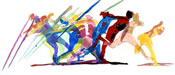
Overlapping Javelin Throw
Born 1962 in Hertford Heath, England, Bradstock began drawing and painting when he was about five years old. Continuing his interest in art throughout school, he completed an advanced two-year sculpture program in one year at Turnford College. Also pursuing his passion for sports, Bradstock ranked #2 in the World Junior Division for the javelin throw in 1981. This victory gained him an athletic scholarship to Southern Methodist University in Dallas, Texas. He earned All-American awards in 1982, 1983, and 1984, and completed his Bachelor of fine Arts degree with honors. Bradstock represented Great Britain at the 1984 and 1988 Olympic Games. In 1986, he broke an 80m world record barrier by throwing a “New Rule” javelin 81.74m. These awards proved to be the impressive beginnings of a continuing series of awards in both art and sports. In 1994, the American Council on Exercise recognized Bradstock’s invention of a new use for a ball with exercises (trademarked as “Boll-o-Boll”) as a legitimate new exercise program. In 1995, Bradstock became an American citizen, although later he would revert to his British citizenship in order to make a bid for the 2012 Olympics. In 1996, he was an alternate for the U.S. Olympic team. He moved to Atlanta, Georgia in 1997. In 1999, Bradstock’s awards included the Ampersand Merit Award in the Juried National Art League Exhibition in New York, best-in-show in the National Sports Art competition in Florida, and first place in the United States Olympic Committee (USOC) Sport Art Competition. His public support of the Olympic Games through his art has gained him the nickname, “The Olympic Picasso.”
Bar Bells
In 2000, Bradstock’s artwork won the USOC Sport Art Competition and was exhibited at the International Olympic Museum in Lausanne, Switzerland, during the cultural activities showcasing the 2000 Sydney Olympic Games. In 2003, Bradstock was honored as Sport Artist of the Year by the United States Sports Academy for his unique art style that promotes athletics and for his efforts to unify the Olympics and Paralympics. In 2006, he became a founding member of Art of the Olympians (AOTO), an Olympic revival movement including other sports icons such as Al Oerter and Florence Griffith-Joyner.
Stainglass Runners
Bradstock spreads his efforts to promote Olympic sports to youth through placing short films of his varied object-throwing stunts on YouTube and touting his resulting obscure entries in the Guinness Book of World Records. Bradstock currently designs exercise clothing covered with colorful abstract designs that he wears to great audience delight when he competes. He wants to continue to participate in Olympic sports as long as his athletic condition allows. At his studio attached to his home in Atlanta, Bradstock continues to develop his art while maintaining a stringent athletic training schedule. Combining hard work with healthy humor, he comments that only three things might keep him from advancing beyond qualifying rounds for the 2012 London Olympic Games: “I’m short, slow, and old.”
Basketball
In 2006, this tireless London-born international advocate for sports instigated a three-week business mission with organizers of the 2012 London Olympics to explore the possibility of implementing his vision for using art at the Games as a unifying, educational tool. His detailed plan is structured in six parts, each focusing on a different means of combining art and athletics to promote the Olympic tradition. Part 1 would employ large art and sports imagery in such media as murals and mosaics to replicate specific Olympic performances. Part 2 would take advantage of the fact that ‘Olympic Javelin’ is the nickname given by the Games’ organizers to the high speed train meant to carry spectators into Olympic Park. Bradstock proposes placing images of medal-winning Olympic javelin athletes on the sides of the trains so that they can be seen speeding through the station. Part 3 proposes an educational program about Olympic history for young children as well as college students. Part 4 is a complex plan to organize the blooming flowers in the Olympic gardens into designs that create sports images. Part 5 would implement an over-sized version of the garden project to organize carefully spaced plants into sports images so large that they could be seen from airplanes landing at Heathrow Airport. These images would honor the famous British landmarks from prehistoric times carved into chalk rock mounds and only viewable aerially. Part 6 involves arranging nationwide art exhibitions at schools and universities to promote the alliance between art and sports as well as the upcoming London Olympic Games. As monumental a task as is his six-part plan, it should not be counted out by doubters. It comes from the athlete-artist-educator who continues to demonstrate that no obstacle is too big for him to tackle when it comes to spreading the good news about Olympic tradition.
Baseball
During 2009, Bradstock worked developing a new sport art workshop series with the United Kingdom’s Youth Sport Trust that is affiliated with over 500 Sport Colleges nationwide. The response to his workshops has been phenomenally positive from students and faculty alike.
In answer to requests for many more workshops, Bradstock will return to England in the summer of 2010 to present additional workshops and expand the program. His goal is to follow the founder of the Olympics’ vision to combine sport, art, and culture in education. Everyone looks forward to the next phase of Bradstock’s program with great anticipation.
“Communication is number one! What is more universal than sport and art? Most people are visual learners… It’s timeless. It crosses over cultures and it crosses technologies… Sport is the universal factor as it combines so many different elements as a sort of foundation course… Combining it with the art, technology, and the education, who knows where it may take you?” ~ Roald Bradstock; “Raise Your Game,” www.BBC.co.uk
Inspiration
Style & Inspiration
Roald Bradstock – “THE OLYMPIC PICASSO” – 2003 SPORT ARTIST OF THE YEAR
“I repeat lines and shapes, as athletes repeat movements and exercises, to capture power and energy. I want all my pieces of art to be unique, powerful, athletic and artistic statements.” ~ Roald Bradstock
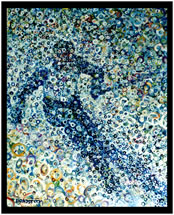
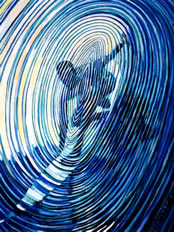
Skier
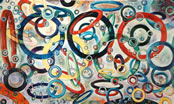
Roald Bradstock’s painting style exhibits many of the characteristics that have made this British-born javelin thrower both a well-loved sports spokesperson and a record-breaking Olympic medal winner. The mood of the majority of his paintings and prints is high-energy, bold, and optimistic. Bradstock often uses bright, primary colors to create signature background patterns of circular hoops, and clear foreground images of athletes involved in various sports. Drawing on elements of Europe’s New Realism and America’s Pop Art, his painting style is called by Bradstock, “Athletic Abstraction.” When asked about his source of artistic inspiration, he responds:
“The Olympics, anything to do with the Olympics… My art is all about reaching the youth and how they communicate.” (spikesmag.com/features/roaldbradstock
Polo8
Bradstock believes that sports and art support each other and that art can teach young people about improving their athletics. When he was 19 years old, he was forced to choose between an art career and a sports career because of the school system.
“That’s one of the things I want to help change within education, so that other people don’t have to make that choice. There are more and more athlete-artists out there.” (bbc.co.uk/wales/raiseyourgame)
Bradstock’s bright nearly-neon color palette, geometric design backgrounds, and representational images of contemporary activities indicate Pop Art as a major influence on his style. Emerging in Great Britain and the United States in the late 1950s as the foremost avant-garde art style, Pop Art has three key characteristics: (1) it is both realist and figurative; (2) its manifestos urge artists to select subjects from their contemporary urban culture; (3) the works are designed to encourage viewers to take a fresh look at the powerful symbolism inherent in everyday objects.
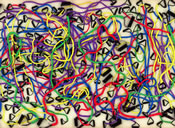
Yoga Mats
Europe’s New Realism movement with its re-examination of the commonplace began to influence America’s Pop Art movement earlier in 1915 when leading French artist, Marcel Duchamp brought a New York collector some of his “found art,” an everyday souvenir of Paris sealed ceremoniously inside a clear plexiglass box. European and American artists’ ideas would continue to cross-pollinate as Dada, New Realist, and Accumulation art movements’ followers shared ideas and were inspired to move in the direction of recognizable subjects, an unnatural, heightened color palette taken from advertising, and a fascination with daily life objects and activities.
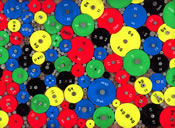
Olympic Circular Lifting Plates
Pop Art reached its popular zenith under the leadership of Andy Warhol, who reigned over the Pop Art world exhibiting a public presence and a media savvy previously unknown in New York’s exclusive art scene. Bradstock follows Pop Art’s three key characteristics in his artworks: (1) focused on recognizable subjects (2) involved in contemporary activities (3) painted in neon-bright colors. His work encourages viewers to look more closely at their everyday activities, especially sports.
Ocala Winter Circuit
Bradstock believes that the qualities that improve his art also improve his athletics. His sports style is as intense and optimistic as his art style. Age 30 used to be considered over the hill for a top sports star. Today, better diet and training methods have raised that barrier to age 40. Looking on these numbers as mainly mental barriers, Bradstock sustains a positive attitude along with a rigorous training schedule. His goal is to be involved with the 2012 Olympics, hopefully as an athlete at age 50 and otherwise as an event designer and artist. Bradstock says that’s what the Olympics is all about – being inspired, taking a chance, reaching for the stars. Along with his Olympic-sized optimism in light of his age-related limitations, Bradstock maintains a balanced sense of humor:
“I just don’t have the height. I used to be 5’ 11”. Then I lost some hair” (nytimes.com/2008/07/06/sports).
Record Breakers
Bradstock displayed another aspect of his game attitude when he agreed to participate in a mullet throwing competition. The first athlete to participate in this fishy event was Ken Stabler, the great Oakland Raiders quarterback from Alabama University. Exceeding the previous thrower’s pitch of 187 feet, Bradstock threw a wet mullet 196 feet 9 inches across the state line separating Florida from Alabama.
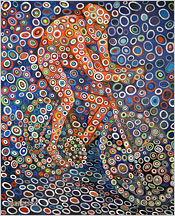
Cyclo-Drama
Bradstock’s athletic training has paid off in more serious arenas as well. In 2009, his throw of 72m was the fifth best by a British athlete of that year. It also set a new world age record and it boosted his hopes of competing in 2012. “Every day I go out and I can still throw, I’m very appreciative of it because I don’t know when it’s going to end.” (news.bbc.co.uk/sport) Repetitious training in the face of physical limitations and numerous sceptics have built Bradstock into one of the world’s finest javelin throwers.
Repetitious designs have become Bradstock’s trademark surround for his celebrated sports paintings. As he repeats his personal formula for success combining hard work and focused optimism, Bradstock inspires countless admirers to apply similar efforts toward achieving their own goals. Bradstock’s life mission to share the benefits of sport and art spreads the enduring spirit of The Olympics.
“I’ve managed to pursue both my passions and I’m living my dream… Part of the learning process is losing, failing… It ties in again with sport, art, and life… You move on and you try and do better next time.” ~ Roald Bradstock; bbc.co.uk/wales/raiseyourgame
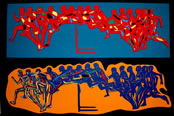
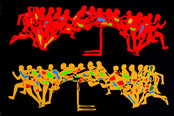
Hurdle Double Seq
Sandtrap
Key Sport Works & World Influence
Roald Bradstock – “THE OLYMPIC PICASSO” – 2003 SPORT ARTIST OF THE YEAR
“I want to bridge sport and art and bring the Olympics and Paralympics closer together.” ~ Roald Bradstock
Struggle for Perfection
1984 & 1988
Represents Great Britain in javelin throwing at the Olympic Games
1985
Breaks British 90m “Old Rule” javelin record with throw of 91.40m/299’ 10”
1986
Breaks world 80m “New Rule” javelin record with throw of 81.74m
Hurdle Jumpers Sequence
1994
Recognition by American Council on Exercise of invention of an exercise system
1999
Ampersand merit Award, National Art League Exhibition, New York
Best- in-Show, National Sports Art competition, Florida
First Place, USOC Sport Art competition
Breaks world 80m “New Rule” javelin record with throw of 81.74m
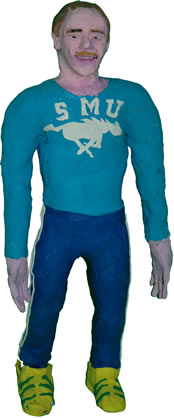
Doll
2000
United States Olympic Committee Sport Art Competition winner
2003
Sport Artist of the Year Award, the United States Sports Academy, Daphne, Alabama
2006
Founding member, Art of the Olympians (AOTO)
Presents plan for 2012 London Olympic Games art events
2009
Workshop series through the Youth Sport Trust in the United Kingdom
2010
At age 47, breaks UK javelin throwing distance records for his age group (45-49) to qualify for the UK Championships, June 2010, and the UK Veterans Championships, July 2010