Artist archive
Sergey Eylanbekov
Biography
“Symbolist Sports Sculptor” – 2004 SPORT ARTIST OF THE YEAR
“The powers of darkness will, in time, be crushed by the spirit of light.” ~ Boris Pasternak, author; www.thinkexist.com

The virgin white canvas before the first stroke of paint, the blank marble block before the first chink of a chisel, the long silence before the first notes of musical inspiration — art in every medium includes a cycle of creating something out of nothing. Some artist’s personal stories mirror this process more graphically than others, becoming portraits of how to emerge from recurring flames of destruction to build a productive life again. The remarkable journey of Russian sculptor, Sergey Eylanbekov has evolved through a series of early triumphs, severe losses, and hard-won comebacks into the prestigious, international art career that he has built today.
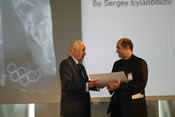
Born in Russia in 1960, Eylanbekov showed talent for art as a youth. At age 13 he entered the topnotch Moscow School of Fine Arts. At the age of 17, he was accepted into the acclaimed Moscow Surikov Academy of Fine Arts. In addition to taking courses in literature and history, students drew and sculpted from live models for six to seven hours a day. After six years of study at Surikov Academy, Eylanbekov graduated with honors.
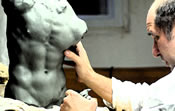
Then, politics reared its head to interrupt his career plans. Under government regulations, he was obligated to serve a minimum of two years in the Russian Army, which he did reluctantly, remarking, “It doesn’t feel right to carry a gun after 10 years of studying art.”
On completion of his years of army duty, he took up his art work again. Living and working in a centrally-located studio in Moscow that he exchanged for teaching art classes to children, Eylanbekov exhibited his artworks and completed private and public commissions. A number of his works were purchased by museums as well as individual collectors. The powerful Russian Ministry of Culture procured several of his sculptures for important museum displays.
“For a country to have a great writer (or artist) is like having a second government. That is why no regime has ever loved great writers.” ~ Aleksandr Solzhenitsyn, author; www.thinkexist.com
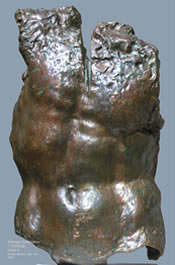
Eylanbekov’s studio’s prime location and minimal “rent” became a double-edged sword. During this chaotic time in Russian history, work space in the center of Moscow was given to those who could pay the most to the local government. In 1989, Eylanbekov’s offer was trumped by a larger one, and the government forced him out. In a desperate attempt to salvage his career, he maneuvered a way to leave Russia the same year and immigrate to the United States. Landing in New York City, speaking no English and without funds, contacts, or influence, he was forced to start over from nothing.
Eylanbekov’s professional road to success would prove to be a hazardous, difficult one. Not savvy about American business practices, he fell into many pitfalls dug by unscrupulous industry bosses and art dealers. Eylanbekov first took menial work in a Manhattan print shop. Next he switched to a company that specialized in mass produced reproductions of famous classic and contemporary sculptures. Eylanbekov’s fine art reproductions became endorsed by many major US museums. His long years of perfecting sculpting skills and his extraordinary talent for representational figures quickly made his work for the company very valuable, but he longed to escape into producing his own original works.
“Justice is like a train that is nearly always late.” ~ Yevgeny Yevtushenko, poet; www.thinkexist.com

As much as time and budget would allow, he continued sculpting and producing his own works in bronze. He also played the guitar in a New York band until the demands of caring for two young children took precedence. As a result of showing his paintings as well as sculptures, gradually, Eylanbekov’s exceptional talents came to the attention of important collectors in the New York art world and also art aficionados in other parts of the world. In 1991, Eylanbekov was inducted as a Professional Member into the prestigious United States National Sculpture Society. In spite of many difficulties during this time of struggle to adapt to a new country, positive results from his years of hard work began to emerge. In 1992, his portrait of President Reagan was placed in the Presidential Library. More commissions and exhibitions followed. Included in his early works is a bronze bust of football great, Frank Gifford, that sits in the sports star’s private home. In 1996, he was elected a National Sculpture Society Fellow and in 1997, was chosen to sit on the National Sculpture Society’s Board of Directors.

Eylanbekov was also pursuing a new passion for producing sculptures in the innovative medium of sculpture-grade acrylics. His beautiful, multi-dimensional images brought him more acclaim. The year 2000 marked his premier acrylic sculpture unveiling. This artistic exploration would lead to significant advances in his career.
“I am fascinated by acrylic. Its transparency opens the door to a whole new world of the visible and the invisible in three dimensions.” ~ Sergey Eylanbekov
In 2002, he became an Official Artist for the Salt Lake Olympic Winter Games. He also produced the magnificent work that became the US Olympic Team Commemorative Statue. In 2003, Eylanbekov’s sculpture titled, “Five Continents,” won the United States Olympic Committee’s Sport Art Competition and was then entered into the international competition. Competing against entries from 39 countries, Eylanbekov’s sculpture won the International Olympic Committee’s (IOC) Sport Art Competition for the 2004 Athens Olympics. This award marked an important career turning point and brought significant new international attention to Eylanbekov’s work. “Five Continents” was scheduled for permanent display at the Olympic Museum in Lausanne, Switzerland, after being exhibited at the 2004 Olympic Games in Athens. Also in 2004, the United States Sports Academy’s American Sport Art Museum and Archives (ASAMA) named Eylanbekov the Sport Artist of the Year. With great respect for Eylanbekov’s artworks, President and CEO Dr. Thomas P. Rosandich of the United States Sports Academy became one of Eylanbekov’s most enthusiastic admirers, helping his work find more exposure around the world.

The artist’s life cycle came full circle in triumph as he was honored with an exhibition of his sculpture at the Museum of Modern Art in Moscow in 2006. That same year provided another honor when his “Seven Tormented Bronzes and Other Works” went on display at the United Nations Secretariat Building, United Nations Headquarters in New York. Eylanbekov worked for several years on various projects in Italy, including preparations for submitting his sculpture for the Ibsen Park in Norway.
April, 2010 brought Eylanbekov the honor of presenting his sculpture, “Victory,” as the official Business Council for International Understanding (BCIU) International Peace and Harmony Award to the First Lady of Malaysia at a ceremony in New York City. Continuing his worldwide recognition, Eylanbekov won an international competition for his sculpture in honor of the Norwegian playwright, Henrik Ibsen. Titled, “Peer Gynt & Three Herd Girls,” the seven foot bronze has an installation date of August 2010 at the Henrik Ibsen Park in Oslo.
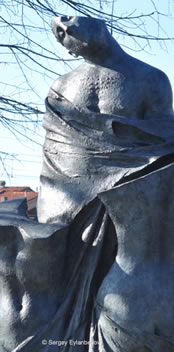
Currently, Sergey Eylanbekov lives on Long Island. He teaches drawing and sculpture freelance at various institutions, including Farmingdale State University of New York, Lyme Academy College of Fine Arts, and Brookgreen Sculpture Gardens in South Caroline, while also pursuing his sculpting. Eylanbekov’s mastery of sculpting the human form puts him at the top of his profession and brings him special acclaim in the field of sport art. His challenging journey has taken him around the world and brought him to his rightful place in art today as one of the finest and most inspiring contemporary sculptors.
“Art is a human activity having for its purpose the transmission to others of the highest and best feelings to which men have risen.” ~ Leo Tolstoy, novelist; What is Art?
Style & Inspiration
Sergey Eylanbekov – “SYMBOLIST SPORTS SCULPTOR” – 2004 SPORT ARTIST OF THE YEAR
“Every good sculpture should possess some concealed energy within, the kind of energy that is felt beyond the physical limits of the work.” ~ Sergey Eylanbekov
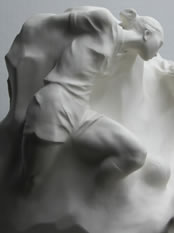
Eylanbekov’s statement that good sculpture should radiate energy is similar to Abstract Expressionist painter, Mina Papatheodorou-Valyraki’s statement that she aims to extend her works’ sensations beyond the canvas: “I don’t have restricted boundaries. I always want to go outside the frame anyway. Almost all my works are cut off. The remainder of their ‘being,’ the imaginary, exists outside the frame”(Dialogue about Art, Livani Publishing, p. 31). Valyraki acknowledges the work of Russian artist, Wassily Kandinsky as one of her key influences. In 1908, he was one of the first artists to elevate Expressionism beyond personal emotions into a larger spiritual realm when he fused it with Russian Byzantinism’s abstract symbolism. Kandinsky was a master of the Gestural Avant Garde style in which the gesture of the artist held prime value either in its record in a painter’s brushstroke or a sculptor’s chisel scraping. Tool marks were intentionally left unsmoothed to convey the personal touch and energetic intent of the artist more directly.
“Art is interested in life at the moment when the ray of power is passing through it.” ~ Boris Pasternak, author; www.people.ubr.com

Eylanbekov’s style of sculpting includes many works in which he uses this Contemporary Expressionist approach with strong Symbolist influences. Rigorously trained in drawing and sculpting the human body with anatomical precision, Eylanbekov often alters his figures slightly to communicate something about the subject’s emotions or energy rhythms. His bronze sculptures are recognizable representations of their subjects’ faces with subtle added strokes and distortions that heighten the portraits of their characters and moods. These techniques indicate strong influence by art from the Abstract Expressionist as well as Gestural movements. They give his human figures intense vitality along with a dose of mystery from the implicit energy.
“Overall, my style probably could be described as Contemporary Expressionism with a large dose of Symbolism.” ~ Sergey Eylanbekov
The masterful works of American artist, Leonard Baskin, are important influences on Eylanbekov’s art. Baskin rejected the confines of media specialization and the devaluation of figural humanism embraced by many of his contemporaries. Eylanbekov clearly shares Baskin’s interest in figural sculpture and drawing as well as an affinity for archetypal, sometimes unsettling themes. Baskin’s symbolic portraits in ink and bronze stand as some of the finest, most original artworks of the 20th century.
“Sculpture at its greatest and most monumental is about simple, abstract, emotional states, like fear, pride, love, envy.” ~ Leonard Baskin
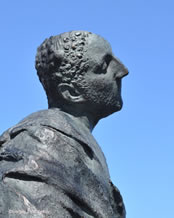
Along with Auguste Rodin and Alberto Giacometti, Eylanbekov cites the styles of two Italian 20th century sculptors as major influences on his work. Giacomo Manzu produced somber religious sculptures of elongated human figures much influenced by the figures in Romanesque cathedrals. He was also influenced by ancient Etruscan art and its tall, stately, stylized portraits. Manzu was devoted to using the human figure to convey universal symbolic themes. His contemporary, Marino Marini also sculpted elongated figures but he imbued them with his signature qualities of lightness, humor, and personal mythology. Marini was greatly influenced by his colleague, Henry Moore whose streamlined sculptural forms had a significant impact on the styles of many contemporary artists.
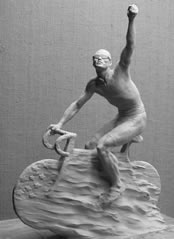
After the 1980s, Pluralism, or the freedom to use any styles in any combinations became the approach of most artists. Eylanbekov combines the rebellious mood-enhancing techniques of the Expressionists with the precise artistic skills of traditional approaches into his unique, powerful style.
Eylanbekov’s art career has been raised to a new level of excellence by his mastery of a contemporary technique employing sculpture-grade acrylics. First used for fine artworks by 20th century American master sculptor, Frederick Hart, the use of acrylic material to create multi-layered carvings is a technique that Eylanbekov has modified and made his own. Some of his finest sports sculptures are created in this medium. The images take on the appearance of moving through the atmosphere as the opaque blocks of acrylic are rotated, and the figures emerge from different angles. Even more than on bronze sculptures, light and shadow take major roles as they filter through an acrylic realm modifying the form and mood of the piece in various positions.
“Sculpting with acrylics is sculpting with light.” ~ Frederick Hart; www.angelakinggallery.com
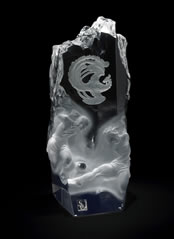
The Russian composer, Sergei Rachmaninov said of his creative pursuits, “Music is enough for a lifetime, but a lifetime is not enough for music.” In light of the enthusiastic public response to Eylanbekov’s impressive sculptures, it is clear that Eylanbekov’s works will continue to enlighten and delight viewers for many lifetimes to come.
Key Sport Works & World Influence
SERGEY EYLANBEKOV – “SYMBOLIST SPORTS SCULPTOR” – 2004 SPORT ARTIST OF THE YEAR
-
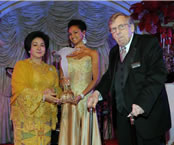
First Lady of Malaysia 1978
- 84 Moscow Surikov Academy of Fine Art
- 1984
- Russian Academy of Fine Arts Award
- 1984-86
- Obligatory service in Russian army
- 1987-89
- Sculpture exhibitions in Russia, Czechoslovakia, West Germany
- 1989
- Closing of Eylanbekov’s art studio by Russian government
- Immigrates to U.S.A.
-
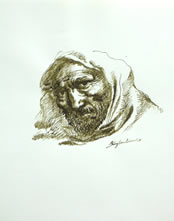
Portrait of a Boxer 1991
- Professional Member, National Sculpture Society, USA
- 1992
- Bronze of US President Regan placed in Presidential Library
- 1993
- Lance Chilmark Award & Silver Medal
- 1994
- National Sculpture Society Exhibition, 61st Annual Exhibition, New York
- 1995
- Roger T. Williams Young Sculptors’ Award
- National Sculpture Society Exhibition, Palazzo Mediceo, Seravezza, Italy
- 1996
- National Sculpture Society Fellow
- 1st Place, National Sculpture Competition, Pennsylvania Academy & Lyme Academy
- Walter & Michael Lantz Prize
- Edward Fenno Hoffman Prize for Outstanding Achievement
-
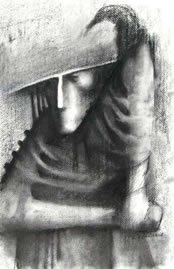
Man with a Bird 1997
- National Sculpture Society Board of Directors
- Tallix Foundry Prize
- Artist Showcase Award, Manhattan Arts International Magazine
- 1998
- National Sculpture Society 65th Annual Exhibition
- 1999
- National Sculpture Society 66th Annual Exhibition
- “Masterworks of American Sculpture,” Fleischer Museum, Scottsdale, Arizona
- 2000
- Eylanbekov’s Acrylic Sculptures Premier Unveiling
- 2002
- Official Artist, Salt Lake Olympic Winter Games
- 2003
- United States Olympic Committee Sport Art Competition, 1st Place
- 2004
- United States Sports Academy Sport Artist of the Year
- Grand prize in worldwide Olympic Art and Sport Contest in commemoration of the Olympic summer Games, Athens, Greece
- 2007
- Acrylic sculpture for FIFA Women’s World Cup
- 2010
- “Victory” sculpture presented by Business Council on International Understanding (BCIU) as International Peace & harmony Award to First Lady of Malaysia, Madame Rosmah Mansor, NYC
- International competition winner, bronze honoring Henrik Ibsen , Oslo, Norway; installation of statue, “Peer Gynt & Three Herd Girls”
“I love sport because I love life, and sport is one of the basic joys of life.” Yevgeny Yevtushenko, poet; www.brainyquote.com