Artist archive
TAFA
Biography
“Sport Art’s Sacred Drummer” – 2010 Sport Artist of the Year
Artist Biography
“Artists are like the shamans in most native cultures; they are sacred drummers whose creative works are conduits for spiritual messages from the collective unconscious.”Tafa
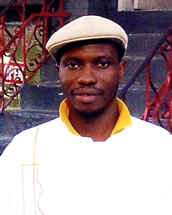
Even though his homeland is Ghana in West Africa, Tafa says that Harlem, U.S.A. has always played an influential part in his daily life. In the capital of Accra where Tafa grew up, he recalls with nostalgia gathering places like the Harlem Café and also The Apollo Theater, one of the major entertainment centers named after the historic hotspot famous in New York as the showcase for glittering African-American talent during its heyday in the early to mid-1900s. On both continents, these cafes and nightclubs served as centers of social and cultural exchange as much as they functioned as entertainment centers. Tafa completed his Bachelor of Arts Degree from the College of Art, Kwame University of Science and Technology in Ghana. Today, Tafa lives and maintains his painting studio in Harlem, New York, where he continues to engage in the artistic cross-cultural pollination that inspired many of his childhood dreams of becoming an international artist.
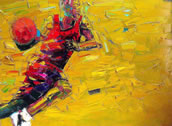
Tafa says that he has been moved to create art from infancy, since he “heard the drums through my mother’s umbilical cord.” The many top flight cultural institutions in New York such as the Metropolitan Museum of Art, the Museum of Modern Art, plus the rich variety of ethnic communities provide endless artistic stimulation. In New York harbor, The Statue of Liberty draws Tafa’s attention in a special way because of its symbolic celebration of multi-cultural tolerance and civil liberties, issues close to his heart. In 2002, Tafa created an installation titled, Blindfold the Statue of Liberty, on Ellis Island to spotlight these themes. He also believes that sports scenes illustrate similar kinds of themes.
“I paint sports themes because they are a universal form of communication that is replete with powerful, multi-layered symbolism. Team sport fosters hard work, fraternity, excellence, and international understanding. Sports can bridge gaps between people all over the globe. It is an area of life that underlines Dr. Martin Luther King’s vision that people should be judged by the content of their character. In sports, a poor Brazilian boy could blossom into the legendary Pele. Andre Agassi could be an idol of the world.”~ Tafa
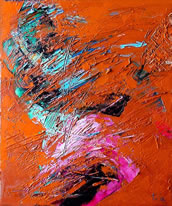
Though Tafa draws on a wide variety of subjects in his artworks, including music, socio-political issues, and religion, sports themes hold a special allure. Tafa sees sports as a vehicle for positive worldwide communication of fraternity and a sense of cooperation among peoples of all nations. His sport art is contemporary, powerful, and unique, marked by the visual characteristics and themes that he has become identified with as an artist: joy in movement and life energy, spiritual awareness, celebration of striving for excellence, diversity with harmony.
“Most painters are also musicians of some sort – painting, music, and breadth are the trinity of harmony in life. The two art forms complement each other. I play the drums a bit, and I love to sing. Recently, while attending a formal dinner in honor of the First Lady of Malaysia’s efforts for world peace, I was urged onstage by the actor, Jamie Foxx, and sang the Zulu national anthem, ‘nkosi sikeleli Africa’, with him. Sometimes when I paint, I can hear the rhythms and sounds of the hues.”Tafa
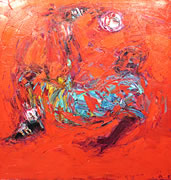
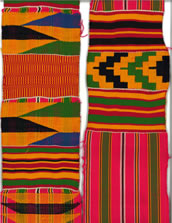
The thick oil paints applied by palette knife, strong designs with distinct sections of bright colors, and spiritual themes combined in his unique patterns often laid down in vertical strips are key elements in Tafa’s new vision of sports topics. These elements and patterns reflect a lifetime of exposure to one of Africa’s cultural gems, the exquisite hand woven Ashanti and Ewe textiles of Ghana called kente cloths. Subconsciously, Tafa structures many of his most beautiful and powerful paintings in the strips of bright color and abstract shapes characteristic of these weavings. The fact that the abstract designs and color schemes of kente cloths are all symbolic of spiritual themes makes this underlying aspect of Tafa’s style a powerful element to enrich his expert sense of structure and energizing paint textures.

In 2010, the United States Sports Academy honored Tafa with their Sport Artist of the Year award for his unique contribution to the field. He visited the campus in Daphne, Alabama, to receive his award. Numerous galleries, museums, cultural and educational institutions, and private collections exhibit his works, including the Superior Court, Washington, D.C., the National Museum of Ghana, the Swiss Collection, Carver Federal Bank, and the private collection of former New York City Mayor, David Dinkins. The Federation of International Football Association (FIFA) coordinates an art exhibit along with many of its sports events. In 2010, FIFA has organized a travelling art show associated with their soccer events in South Africa. Two paintings by Tafa are included in this international exhibit.
A prolific painter of unique contemporary visions, Tafa follows the calling of sacred drummer from his African heritage to communicate spiritual healing through his art. As a native of Ghana, resident of New York, citizen of the world, and international artist, Tafa hopes to spread a message of global peace and tolerance with his paintings. Sometimes he is asked what kinds of themes he would like people to think about while viewing his artworks. Tafa often responds with words engraved on a plaque inside the Statue of Liberty that express the classic humanitarian dream, not only of Americans, but also shared by the entire human family and all the major religions: “Give me your tired, your poor, your huddled masses yearning to breathe free!”(The Ticker, vol. 82-5, Baruch College,2002).

Style & Inspiration
TAFA – “Sport Art’s Sacred Drummer” – 2010 Sport Artist of the Year
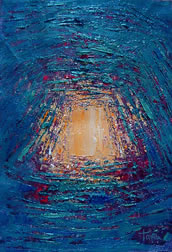
“I use a palette knife because I want to paint a lyrical drum song of motion, energy, rhythm, spirit, and spontaneity.” ~ Tafa

Tafa’s art style is often labeled Abstract Impressionism, though this label only partly covers the scope of his sources. Tafa cites traditional African wood carvings, Impressionism, Expressionism, and Michelangelo Buonarroti’s works as some of his major inspirations.

Though a product of art movements of the early 20th century, it is fitting that Impressionism exerts a strong artistic influence on this very 21st century artist. Impressionism ushered in an art revolution that blew away the confining realism of previous generations and ushered in techniques based on modern science that offered radical options for artists in all media. Now based on its influence, Tafa has expanded Impressionism’s principles into new visual and philosophic arenas to create his unique, contemporary, global art style.

One key aspect of contemporary art styles is visible respect for the art of native cultures. Tafa admires several of the core elements of traditional African wood sculpture: the streamlined abstraction of form that emphasizes its symbolic elements, the sense of intense power that directly confronts the viewer, and the monumental feeling that exudes from the largest to even the most miniature carvings. Tafa’s paintings incorporate these elements. The mastery of abstract design, the balance of proportion, and the depth of the colors create an intensity that makes it impossible to tell from a photograph what size one of his paintings might be. Even one of the smallest of Tafa’s portraits of sports arenas, the black and yellow oil titled, 3rd Quarter, conveys the immense power that emanates from a huge contemporary sports stadium during a spectator-packed game from within its remarkable 7¼” by 9” borders.

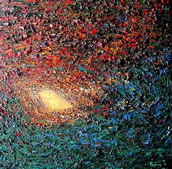
Inspired by the new technology of cameras, film,and modern printing, the pointillist techniques pioneered by 20th century Impressionist painters attempted to break color down into separate dots that fuse into recognizable forms in the viewers’ eyes only when seen at a distance. Tafa modifies this technique by painting split areas of color applied with a palette knife. This tool insists on large streaks of paint rather than delicate tiny dots. In the resulting paintings, Tafa achieves the shimmering effects desired by the Impressionists along with new layers of movement and intensity implied by the strong visible strips of knife-applied color that clearly communicate the physical force of the artist’s hand.
Tafa admires the genius of the 15th century Italian artist, Michelangelo’s paintings with his complete mastery of form, composition, and spiritual symbolism. Tafa aims to fuse these varied influences into his own style in order to capture brief moments of time, motion, and spiritual awakenings. Tafa views the sports stadium as a sort of temple and the game as a sort of religious ritual for today’s masses.
“Kente is more than just a cloth. Like most of Africa’s visual art forms, Kente is a visual representation of history, philosophy, ethics, oral literature, religious belief, social values and political thought… reserved for… special social and sacred functions.” History of Ashanti Kente Cloth; http://kente.midwesttradegroup.com
Tafa believes that sports offer rich contemporary themes for his symbolic aims because in sports the players are equal and excel only based on their levels of talent, teamwork, and strength of character. More than the individual star athlete, the arena where these contests of character take place interests Tafa as subjects for his paintings. As powerful as the ancient abstract masterpieces of Ashanti and Ewe weaving from his African heritage, Tafa’s contemporary masterpieces created in his Harlem studio are not portraits of people, but of universal moments of high energy, of miracles of movement and textural rhythms, and of the inspiration of heroism.


Key Sport Works & World Influence
TAFA – “Sport Art’s Sacred Drummer” – 2010 Sport Artist of the Year
Selected Shows
- 1990
- Camden Center, London, UK
- Black Arts Gallery, London, UK
- Great Hall, Kumasi, Ghana
- 1992/1993
- Boniface Gallery, NYC
- Yeshiva University, NYC
- Shell Head Office, Accra, Ghana
-
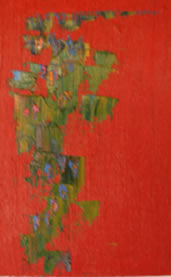
Red Ascension 1994/1995
- African-American Institute, NYC
- Parish Gallery, Washington, DC
- Howard University, Washington, DC
- Pepsico Head Office, Rye, NY
- Bronx River Gallery, Bronx, NY
- Lamu Gallery, NYC
- L’ecrivain Gallery, Brooklyn, NY
- 1996/1997
- Liazan Gallery, NYC
- L’ecrivain Gallery, Brooklyn, NY
- Quiskeya Gallery, NYC
- Crossroads Theater, New Brunswick, NJ
- Contemporary Afri-Art Gallery, London, UK
- 17 West 121Gallery, NYC
- Great Hall, Kumasi, Ghana
- Ayaso Gallery, Washington, DC
- African-American Institute, NYC
- Howard University, Washington, DC
- Pepsico Head Office, Rye, NY
- Bronx River Gallery, Bronx, NY
-

TAFA 1997-1999
- N. Carolina Central Univ., Art Museum, NC
- Frontier Art, The Hague, Netherlands
- Jazz Museum, SoHo, New York
- Fort Frederik Museum, St Croix
- L’Agent Art International, Montreal Canada
- Hearne Gallery, Little Rock, AK
- North Carolina A & T, Greensboro, NC
- New World Art Center, SoHo, NYC
- Thelma Harris Galleries, Oakland, CA
- Mehu Gallery, New York, NY
- Imarisha Art House, Brooklyn, NY
- Medgar Evers College, Brooklyn, NY
- 1999 – 2010
- Danforth Museum, Framingham, MA
- Afro-American Museum, Boston
- Atmosphere Gallery, SoHo, NY
- Bomani Gallery, San Francisco, CA
- Ayaso Int. Fine Art, Washington DC
- African American Museum, Dallas Texas
- MoCADA, Brooklyn, NY
- Moore’s Gallery, Detroit, Michigan
- National Black Fine Art Show, Chicago
- Parliament Building, Hessen, Holland
- Awards
- Sports Artist of the Year 2010
- Circle of Art, New York, NY, 2000
- Paa Kwame, Ghana, 1991
- Swiss Painting Competition, 1st Prize,
- Selected Collections
- Shell
- Carver Federal Bank, NYC
- National Museum, Ghana
- Johnny Cochran
- Bryant Gumbel
- Barclays Bank
- Standard Bank
- Mayor David Dinkins, NYC